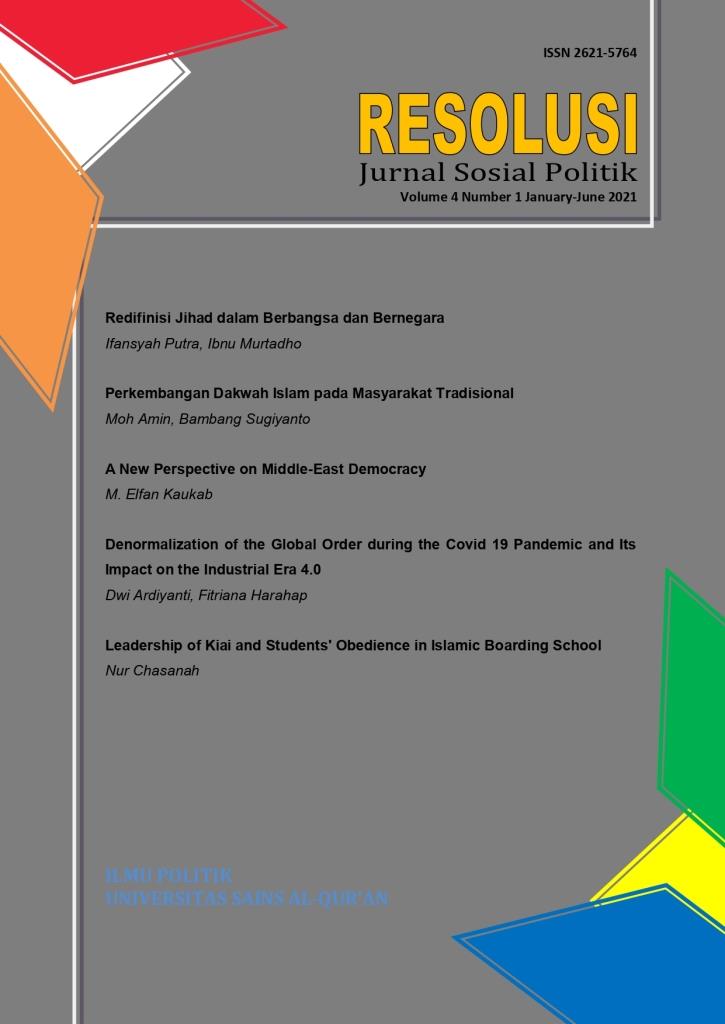
A New Perspective on Middle-East Democracy
DOI:
https://doi.org/10.32699/resolusi.v4i1.1793Keywords:
democracy, arab spring, middle east, politicsAbstract
Spring 2011 was a historic year in the Middle East and was momentum for the rise of people power to overthrow the long-reigning authoritarian regime. This event is known as The Arab Spring. However, on the way, the Arab dream did not come easy. This book tries to capture the opportunities and challenges of democratization in Arab countries after the Arab Spring. There are three countries, namely Tunisia, Egypt, and Syria, which are the focus of this book's study. The interests of the United States (US) emerged as the trigger for democratization efforts. The US does not hesitate to hinder democratization in a country with leaders who are not pro-Western. It is not surprising that democratization in Arab countries is only seen as a US political project to safeguard its national interests. From this book, we can reflect on the situation in Indonesia. Does that also happen?
Downloads
Downloads
Published
Issue
Section
License
All articles published in Resolusi: Jurnal Sosial Politik are licensed under the Creative Commons Attribution 4.0 International Licence (CC BY 4.0). Under this licence, anyone may: share (copy and redistribute) the article in any medium or format; adapt/remix, transform and build upon the article for any purpose, including text and data mining. On these conditions, one shall give appropriate credit to the authors and the journal, provide a link to the licence, and indicate if changes were made, without suggesting that the authors or the journal endorse the reuse;