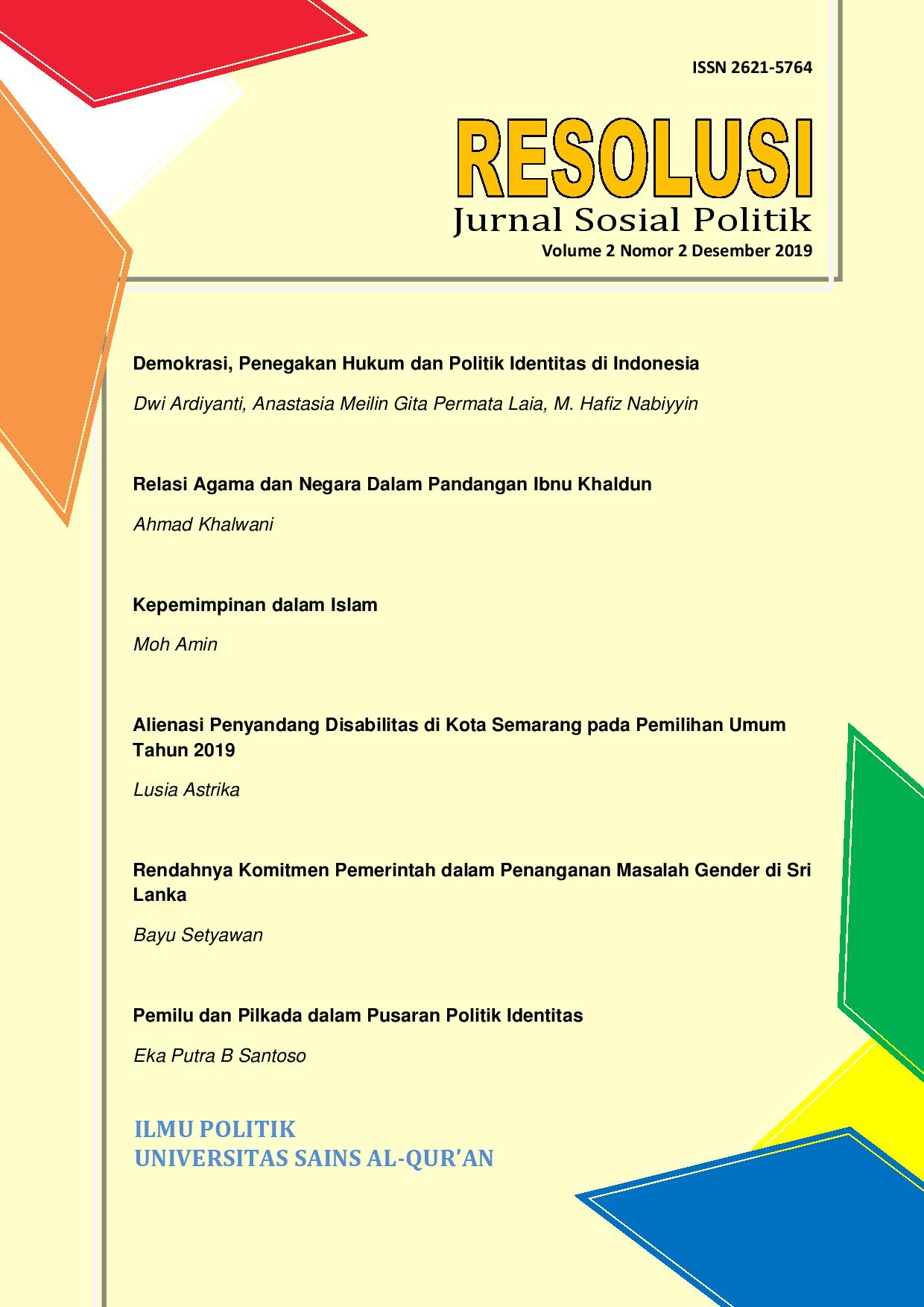
Alienasi Penyandang Disabilitas di Kota Semarang pada Pemilihan Umum Tahun 2019
DOI:
https://doi.org/10.32699/resolusi.v2i2.1020Keywords:
alienation, disability, electionsAbstract
Fulfillment of political rights for everyone in Indonesia is regulated in the 1945 Constitution without any exception, including persons with disabilities or disabilities. In the 2019 elections held in April, the involvement and participation of disabilities should also be taken into account to realize the implementation of a good democratic process so that there would be no misuse of ballots. The problem is that people with disabilities as a minority group often feel unnoticed, so they feel alienated, a human condition that is isolated and kept away from work and ultimately experiences separate or alienated conditions. Twining (1980) enriched the concept of alienation from the approach of social psychology that refers to Seeman's work, with five aspects offered to describe alienation, namely helplessness, insignificance, isolation, irregularity, and self-estrangement. As a concern for persons with disabilities in the city of Semarang to be able to expectedly find solutions, this qualitative study uses a descriptive exploratory type. Informants in this study were determined by purposive sampling technique. Of the five aspects of alienation, there were three aspects experienced by persons with disabilities as voters in the 2019 Elections, namely powerlessness, isolation, and self-alienation. Meanwhile, the two other aspects were not experienced by persons with disabilities as voters. Alienation most often occurs in persons with disabilities who are mentally disabled and physically disabled who are unable to be mobile / totally paralyzed. The government is expected to be able to provide electoral facilities for persons with disabilities to ensure their political rights are fulfilled.
Downloads
Downloads
Published
Issue
Section
License
All articles published in Resolusi: Jurnal Sosial Politik are licensed under the Creative Commons Attribution 4.0 International Licence (CC BY 4.0). Under this licence, anyone may: share (copy and redistribute) the article in any medium or format; adapt/remix, transform and build upon the article for any purpose, including text and data mining. On these conditions, one shall give appropriate credit to the authors and the journal, provide a link to the licence, and indicate if changes were made, without suggesting that the authors or the journal endorse the reuse;