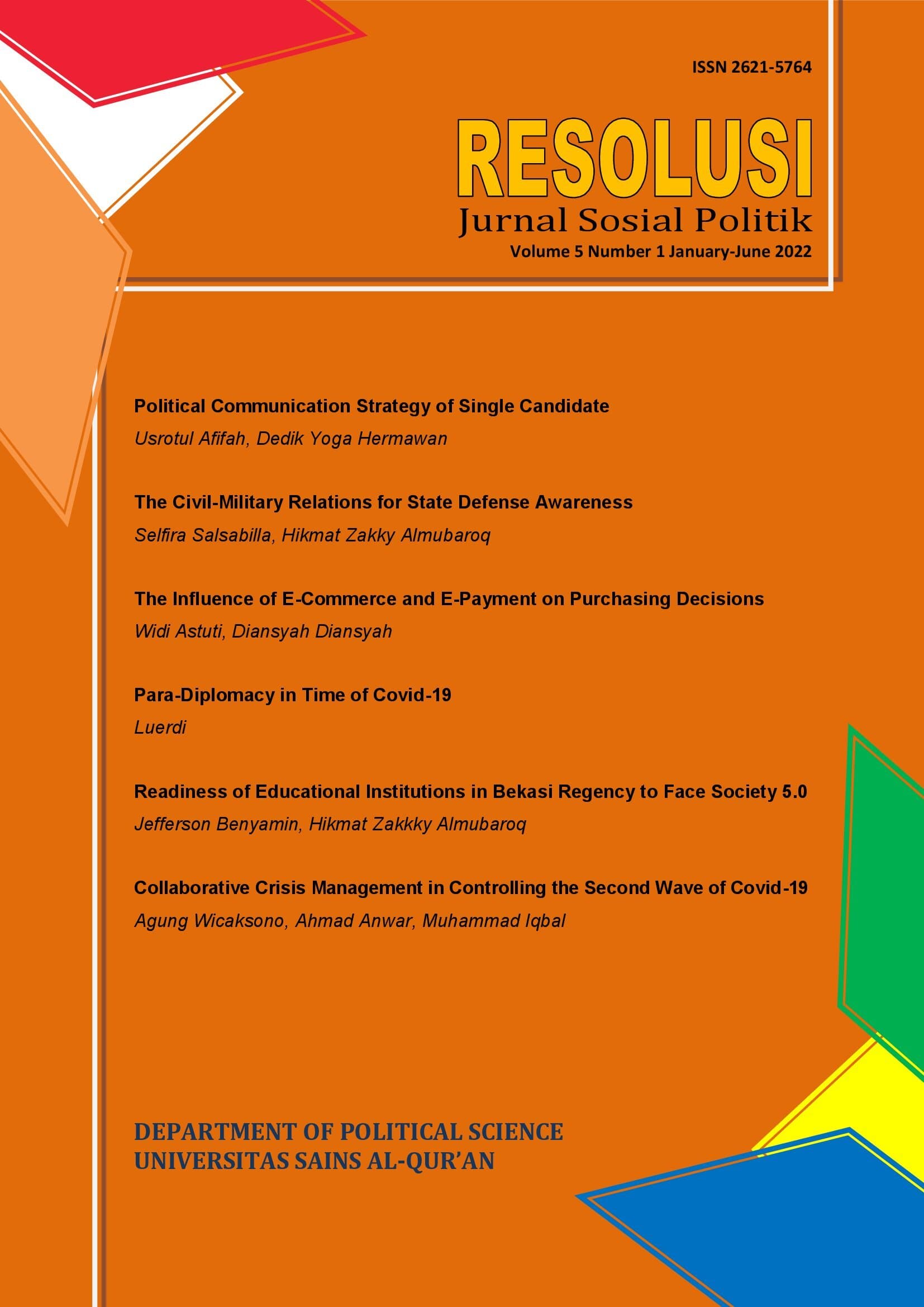
Political Communication Strategy of Single Candidate
The Case of Wonosobo Regional Election 2020
DOI:
https://doi.org/10.32699/resolusi.v5i1.2298Keywords:
communication strategies, election, single candidate, political communicationAbstract
Political communication strategy is very important in elections, both regional and national elections. Political communication strategies carried out by political parties or candidates include several things such as campaigns and collaboration with community groups. This was done to gain votes from the public. This study aims to determine the political communication strategy of a single candidate in the Wonosobo regional election. This research is qualitative research. The main subjects of this research are the main actors in the 2020 Wonosobo regional elections. The results show that a single candidate continues to carry out political communication strategies. The communication strategy is carried out in several ways including campaigning and also establishing cooperation with community groups. The campaigns carried out are generally in the form of installing banners or billboards, interviews with offline media and electronic media, and also visits to the public area. Meanwhile, collaborating with community groups is carried out by communicating between prospective leaders and group administrators, before finally withdrawing the votes of their members. This strategy success to bring the victory of single candidate on regional election in Wonosobo.
Downloads
Downloads
Published
Issue
Section
License
All articles published in Resolusi: Jurnal Sosial Politik are licensed under the Creative Commons Attribution 4.0 International Licence (CC BY 4.0). Under this licence, anyone may: share (copy and redistribute) the article in any medium or format; adapt/remix, transform and build upon the article for any purpose, including text and data mining. On these conditions, one shall give appropriate credit to the authors and the journal, provide a link to the licence, and indicate if changes were made, without suggesting that the authors or the journal endorse the reuse;