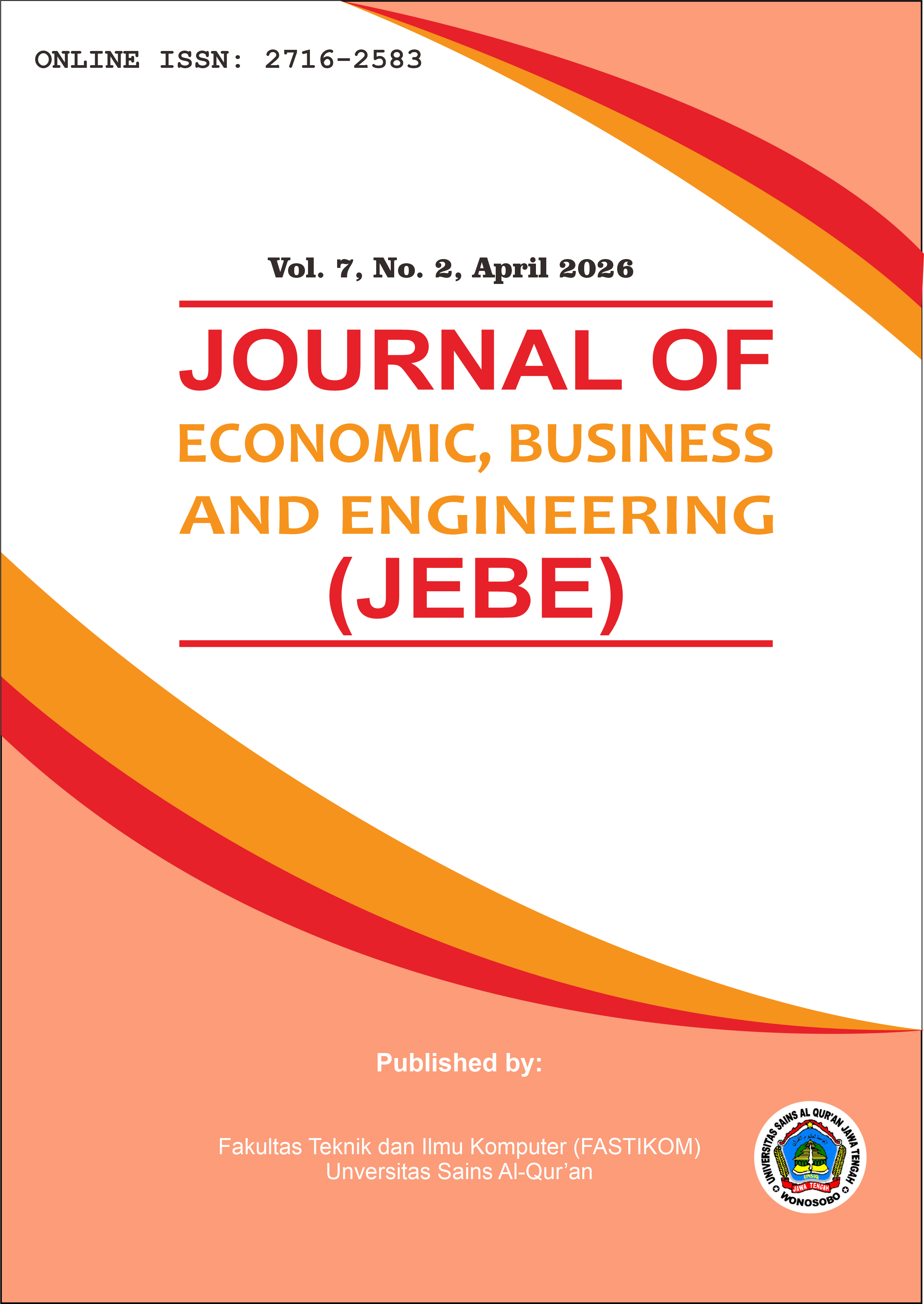
INTEGRATING BLUE ECONOMY AND ISLAMIC PRINCIPLES FOR SUSTAINABLE ECONOMIC AND ENVIRONMENTAL SYNERGY IN THE KARIMUNJAWA ISLANDS
DOI:
https://doi.org/10.32500/jebe.v7i2.10940Keywords:
Blue Economy, Sustainable, Coastal Development, Environmental Synergy, EconomicAbstract
This study aims to describe the synergy between the economy and the environment in the Karimunjawa Islands through the implementation of Blue Economy principles based on Islamic values. This research employs a qualitative method with a field research approach. The research subjects consist of five individuals, including related government institutions such as BBPBAP Jepara; the Secretary of HPI Karimunjawa; Karimunjawa residents, lodging owners, fishermen who are also tour boat owners, as well as other stakeholders involved in the management of marine resources. Data were collected through observation, interviews, and documentation using data analysis techniques including data reduction, data display, and conclusion drawing. The results show that the synergy between economic and ecological aspects in Karimunjawa is realized through sustainable practices, such as the use of environmentally friendly fishing gear, aquaculture activities that meet the standards of Good Aquaculture Practices (CBIB), and the development of conservation-based tourism. This is supported by coral reef monitoring data over the past five years, which indicate that the percentage of coral reef cover in the Karimunjawa National Park area falls into the “good” category (average 64.70%), representing an increase compared to the 2019 coverage of 53.80%. Increases occurred in all zones except the marine tourism utilization zone. Public awareness of marine conservation has also increased, along with the understanding that the sea is a source of life and a trust (amanah) from Allah SWT. Islamic principles such as tauhid (unity of God), khalifah (stewardship), maslahah (public benefit), mizan (balance), and anti-israf (prohibition of excess) serve as the foundation for marine economic activities that balance community welfare and ecosystem preservation. Religious traditions such as Sedekah Laut (Lomban) and Barikan Kubro further strengthen the community’s sense of gratitude and ecological responsibility. Thus, the implementation of a Sustainable Blue Economy based on Islamic values in Karimunjawa reflects a model of coastal development that is just, sustainable, and aligned with the principle of environmental balance (hifz al-bi’ah).
References
Ahmad Hery Sultoni. 2023. “Sustainable Blue Economy Perspektif Al-Qur’an.” Jakarta: Publica Indonesia Utama 146.
Citaningati, Putri Rizka, Tri Alfianto, Universitas Diponegoro, and Universitas Diponegoro. 2024. “Blue Economics in Islamic Economics Perspective: Fiqh Bi’ah Approach.” 7(2):128–60.
Firdaus, Ellina Nuril. 2023. “Analisis Potensi Pengembangan Blue Economy Melalui Potensi Sub Sektor Perikanan Di Indonesia.”
Ha, Le Thanh. 2024. “Achieving a Blue Economy through the Circular Initiatives: A Path towards Sustainable Marine Living Resources.” Environmental Science and Pollution Research 31(9):13656–72.
Hafidh, Hafidh Ali. 2025. “Fostering a Blue Economy Through Islamic Environmental Ethics ( Fiqh Bi ’ Ah ): A Quranic Perspective.” 14(1):33–41.
Harris, Mochamad. 2023. “5 Alasan Indonesia Disebut Negara Maritim.” Gramedia Blog. Retrieved (https://www.gramedia.com/literasi/alasan-indonesia-disebut-negara-maritim/).
Ilma, Ajeng Faizah Nijma. 2016. “Blue Economy : Kesimbangan Perspektif Ekonomi Dan Lingkungan.” Jurnal Ilmu Ekonomi Dan Pembangunan 14(1).
Istiqomah, Nur Hidayatul. n.d. “Strengthening Blue Economy Through Sustainable Aquaculture Based On Islamic Economics And Local.” 152–62.
Iyad Abumoghli. n.d. “The Islamic Principles on Sustainable Development.” Www.Ecomena.Org.
Journal, Indonesian Interdisciplinary and Sharia Economics. 2025. “Dynamics Of Islamic Economic Development In The Past A Decade: A Bibliometric Analysis And Systematic Literature Review.” 8(3):11646–65.
Khoirun Rizky, Misagi Mukhti Ginting, Rahmat Ibrahim Dalimunthe, and Rizki Yawan Wijaya. 2025. “Integrasi Green Economy Dan Blue Economy Untuk Pembangunan Berkelanjutan.” Jurnal Ekonomi Dan Pembangunan Indonesia 3(1):280–89.
Marwa, Taufiq, Muizzuddin, Abdul Bashir, Sri Andaiyani, and Afriyadi Cahyadi. 2024. “Determinants of the Blue Economy Growth in the Era of Sustainability: A Case Study of Indonesia.” Economies 12(11).
Rini, Ayu Dwidyah, Silvester Dian Handy, and Isnawati Hidayah. 2021. “Blue Economy Based Fisheries and Marine Business Model Development.” Jurnal Entrepreneur Dan Entrepreneurship 10(1):43–56.
Shirazi, Nasim Shah and Toseef Azid. 2015. “Circular Economy , Blue Economy , And Islamic.”
Siregar, Muhammad Rafi. 2020. “Sustainable Development Dalam Pembangunan Islam.” Hukum Islam 20(1):81.
Suryati, Rini. 2024. “Ahli Lingkungan Dan Ahli Kelautan Beda Pendapat Soal Kerusakan Karang Karimunjawa.” Kjogja.Com. Retrieved (https://www.krjogja.com/nasional/1244824283/ahli-lingkungan-dan-ahli-kelautan-beda-pendapat-soal-kerusakan-karang-karimunjawa).
Tempo. 2024. Sidang Kasus Petambak Udang Karimunjawa Mencemari Lingkungan Segera Masuki Tahap Tuntutan.
Downloads
Published
Issue
Section
License
Copyright (c) 2026 Journal of Economic, Business and Engineering (JEBE)

This work is licensed under a Creative Commons Attribution-ShareAlike 4.0 International License.