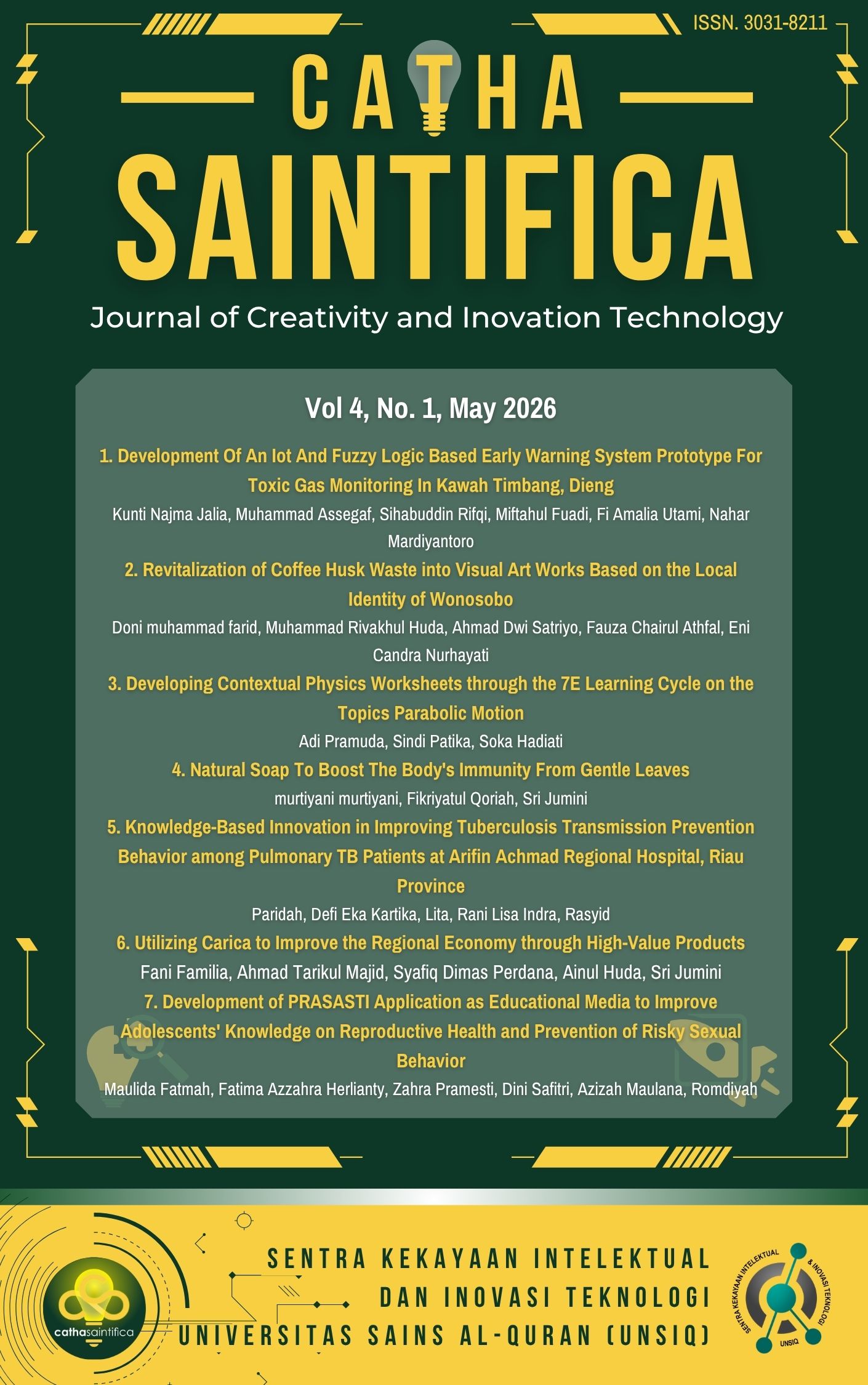
Knowledge-Based Innovation in Improving Tuberculosis Transmission Prevention Behavior among Pulmonary TB Patients at Arifin Achmad Regional Hospital, Riau Province
DOI:
https://doi.org/10.32699/cathasaintifica.v4i1.11222Keywords:
Knowledge, Preventive Behavior, Pulmonary Tuberculosis, TB TransmissionAbstract
Pulmonary tuberculosis (TB) spreads through patients’ daily behaviors such as coughing, mask use, and environmental hygiene all of which depend on how well patients understand TB and its prevenhannya. This study examined the relationship between knowledge and TB transmission prevention behavior among pulmonary TB patients at Arifin Achmad Regional Hospital, Riau Province. A quantitative analytic correlation design with a cross-sectional approach was used. A total of 85 respondents were selected through consecutive sampling according to inclusion criteria. Data were collected via questionnaire from January 13–27, 2026, at the Pulmonary Clinic, then analyzed univariately and bivariately. The majority of respondents were female (51.8%), mostly working as housewives (36.5%), and nearly seven out of ten had only completed primary school (69.4%). Almost all had no family history of TB (98.8%) and had never received prior TB education (97.6%). Bivariate analysis showed a significant relationship between knowledge and TB transmission prevention behavior. The numbers speak for themselves: patients with low education and no formal education tend not to know what to do. A routine and structured education program in the hospital is not merely complementary — it is part of prevention itself.References
Adiutama, N. M., & Fauziah, S. (2022). Relationship between knowledge of pulmonary TB patients and prevention behavior compliance for tuberculosis transmisslaran tuberkulosis. Journal of Public Health, 10(2), 112–120.
Aja, G. K., Omudu, E. A., & Ajanwachukwu, E. A. (2021). Knowledge, attitude and practice of tuberculosis prevention among patients attending chest clinic in Benue State University Teaching Hospital. African Journal of Infectious Diseases, 15(1), 45–53. https://doi.org/10.4314/ajid.v15i1.6
Amelia, R., Sari, D. P., & Putri, N. A. (2021). Characteristics of pulmonary tuberculosis patients by age and gender in referral hospitals. Journal of Health Sciences, 9(1), 23–30.
Bastable, S. B. (2017). Nurse as educator: Principles of teaching and learning for nursing practice (4th ed.). Jones & Bartlett Learning. [ISBN: 9781284127201]
Bloom, B. S. (1956). Taxonomy of educational objectives: The classification of educational goals. Handbook I: Cognitive domain. David McKay.
Crofton, J., Horne, N., & Miller, F. (2009). Clinical Tuberculosis (2nd ed.). Widya Medika.
Depkes RI. (2018). National Guidelines for Tuberculosis Control. Kementerian Kesehatan Republik Indonesia.
Dinas Kesehatan Provinsi Riau. (2022). Health Profile of Riau Province 2022. Dinkes Provinsi Riau.
Fitria, L., Mulyani, S., & Handayani, D. (2020). Distribution of pulmonary tuberculosis incidence by age and risk factors in primary health care facilities. Indonesian Journal of Health Epidemiology, 4(2), 67–74.
Green, L. W., & Kreuter, M. W. (2005). Health program planning: An educational and ecological approach (4th ed.). McGraw-Hill.
Handayani, T., Yulianti, R., & Kurniawan, A. (2021). Contact history and incidence of pulmonary tuberculosis in outpat jalan. Soedirman Nursing Journal, 16(1), 34–41.
Hernawan, A. D., & Lestari, R. (2022). Relationship between type of occupation and the risk of pulmonary tuberculosis transmission. Journal of Environmental Health, 14(1), 55–63.
Hidayat, A. A. (2020). Research Methodology in Nursing and Health. Salemba Medika.
Kementerian Kesehatan Republik Indonesia. (2021). National Tuberculosis Control Program Report 2021. Kemenkes RI.
Kementerian Kesehatan Republik Indonesia. (2023). National Strategy for Tuberculosis Control in Indonesia 2020–2024. Kemenkes RI
Lestari, D., & Dewi, A. (2021). Relationship between education level and knowledge of tuberculosis prevention among pulmonary TB patB paru. Indonesian Nursing Journal, 24(2), 88–95.
Noor, N. N. (2018). Epidemiologi (Revised Edition). Rineka Cipta.
Notoatmodjo, S. (2020). Health Behavior Science. Rineka Cipta.
Putri, A. M., Susilo, C., & Rahayu, T. (2021). Relationship between tuberculosis knowledge and transmission prevention behavior among outpatient pulmonary TB patients. Journal of Nursing Sciences, 9(2), 101–109.
Rahmawati, D., Nurhayati, S., & Pratiwi, A. (2021). Overview of health education history among pulmonary TB patients and its influence on prevention behavior. Community Nursing Journal, 9(1), 44–52.
Ramadhan, F. (2021). Factors influencing tuberculosis transmission prevention behavior among pulmonary TB patients. Journal of Public Health Nasional, 15(3), 130–138.
Rosenstock, I. M. (1966). Why people use health services. Milbank Memorial Fund Quarterly, 44(3), 94–127. https://doi.org/10.2307/3348967
Sari, M., & Rahmawati, F. (2022). Relationship between knowledge level and TB transmission prevention behavior among pulmonary TB patB paru. Nursing Journal, 14(1), 76–84.
Sari, N., Permata, D., & Anggraini, W. (2022). Gender distribution among pulmonary tuberculosis patients in referral health facilities. Health Journal, 13(2), 210–218.
Sugiyono. (2021). Quantitative, Qualitative, and R&D Research Methods (2nd ed.). Alfabeta.
Susanti, R., Hidayah, N., & Wahyuni, E. (2021). Occupational characteristics of pulmonary TB patients and their relationship with treatmhan pengobatan. Journal of Public Health Sciences, 12(2), 98–106.
Widoyono. (2019). Tropical Diseases: Epidemiology, Transmission, Prevention, and Control (2nd ed.). Erlangga.
World Health Organization. (2021). Global tuberculosis report 2021. WHO Pres
Downloads
Published
Issue
Section
License
Copyright (c) 2026 Center for Intellectual Property and Technology Innovation, Universitas Sains Al-Qur’an

This work is licensed under a Creative Commons Attribution-ShareAlike 4.0 International License.
_(1).png)