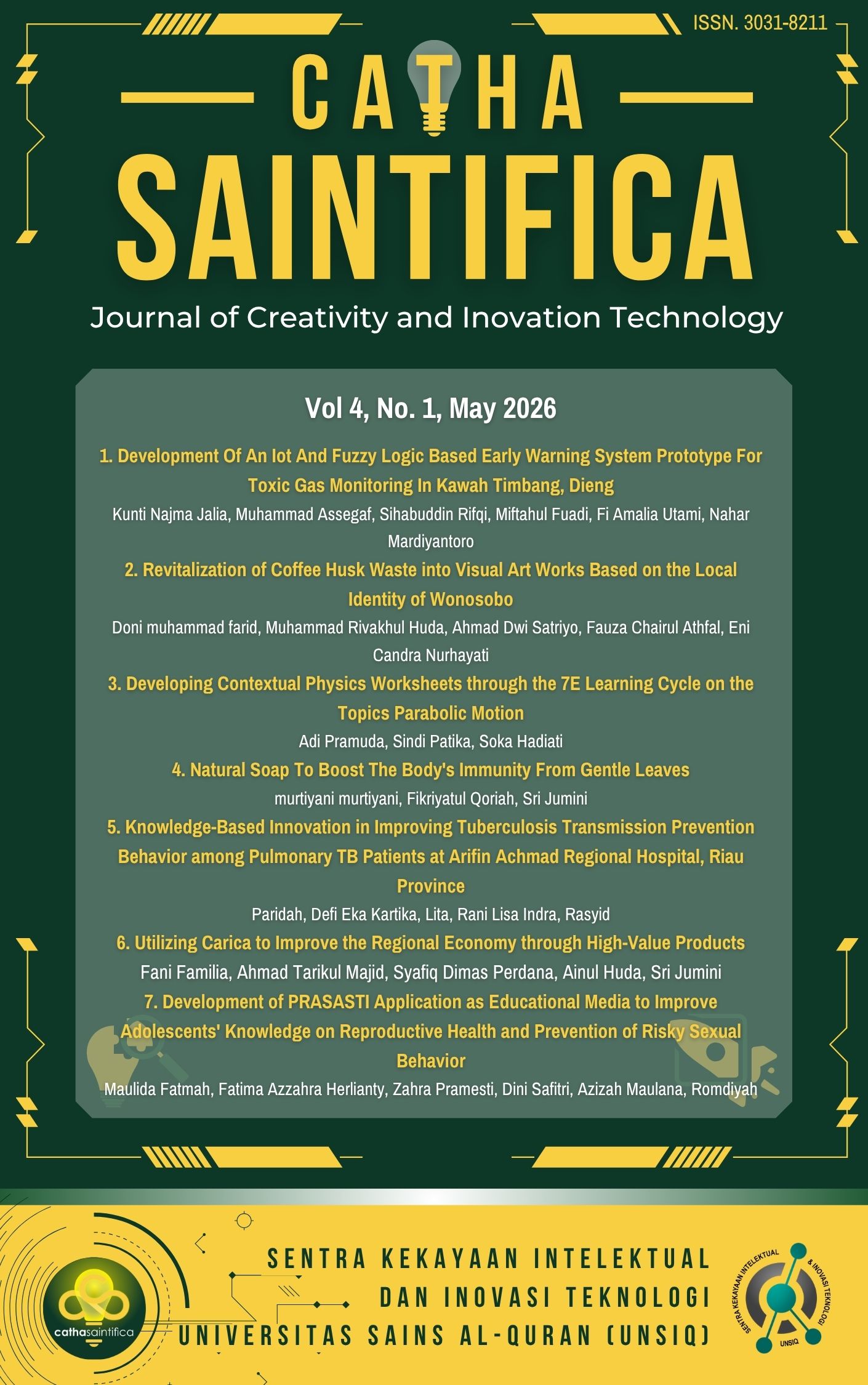
Development of PRASASTI Application as Educational Media to Improve Adolescents' Knowledge on Reproductive Health and Prevention of Risky Sexual Behavior
DOI:
https://doi.org/10.32699/cathasaintifica.v4i1.10824Keywords:
Adolescents, Free Sex, Reproductive Health, Sexually Transmitted Infections , Unwanted PregnancyAbstract
Adolescence is a crucial transition phase vulnerable to risky behaviors such as free sex, which can lead to Sexually Transmitted Infections (STIs) and Unwanted Pregnancies (KTD). This study aims to develop the PRASASTI application and evaluate adolescents' understanding of reproductive health, STIs, and prevention of risky sexual behavior. This study contributes by developing PRASASTI, a digital educational application designed to improve adolescents' literacy regarding reproductive health and the prevention of risky sexual behavior. The research method used was Research and Development (R&D) through the stages of need analysis, design, development, validation, and limited trial, involving 24 IPPNU adolescent respondents in Bogelan Village, Wonosobo. Data were collected using a structured true-false questionnaire and analyzed descriptively using percentage distribution. The results showed that most respondents had a very high level of knowledge: 100% correctly identified STI types, PMS symptoms, and the psychological impact of free sex, while understanding of puberty, HIV transmission, and the physical impact of STIs reached above 85%. In conclusion, PRASASTI is useful as adolescent-friendly educational media that can support reproductive health literacy, strengthen prevention of risky sexual behavior, and encourage healthier decision-making among adolescents
References
Amira, I., Hendrawati, H., Sriati, A., Sumarni, N., & Rosidin, U. (2023). Education on the Prevention of Promiscuity in Adolescents. Journal of Community Service Creativity (PKM), 6(10), 4132-4141.
Bachruddin, W., Kalalo, F., Kundre, R., Nursing, I., & Medicine, F. (2017). The influence of counseling about the dangers of free sex on teenagers' knowledge about free sex at Binsus 9 Manado State High School. UNSRAT Nursing Journal, 5(1), 110631.
BKKBN. (2014). Adolescent Population Profile Study (10-24 years): What's wrong with teenagers? BKKBN.
Budiarto, Y. (2019). A Preliminary Study of Attributions and the Emotion of Shame in Adolescents: A Qualitative Survey Analysis. Persona: Indonesian Journal of Psychology, 8(1), 139-161.
Febriany, S., Yamani, L. N., & Setyowati, D. (2024). Analysis of Knowledge in Adolescent Girls at the Beginning of Menstruation. Indonesian Health Promotion Publication Media (MPPKI), 7(4), 964-970.
Hanifah, S. D., Nurwati, R. N., & Santoso, M. B. (2022). Teenage Sexuality and Free Sex. Journal of Research and Community Service (JPPM), 3(1), 57.
Italia, I., & Ramona, Y. (2021). Literature Study Analysis of Handling Premenstrual Syndrome (PMS) in Adolescent Girls. JKM: Independent Nursing Journal, 1(2), 183-190.
Puspita, L. (2017). Analysis of Factors Associated with the Incidence of Sexually Transmitted Infections in Female Sexual Workers. Aisyah Journal: Journal of Health Sciences, 2(1), 31-44.
Riyatin, R., Suryono, S., & Haryanti, T. (2019). Factors Causing HIV/AIDS Transmission to Women in Sragen Regency. Periodical Journal of Public Health Sciences (JIKeMB), 1(1), 14-22.
Rukmasari, E. A. (2024). Preventing Unwanted Pregnancy (KTD): Reproductive Health Education for Adolescents. Civil Service Journal, 5(1), 1-8.
Safira, D., & Yarni, L. (2024). Puberty development. Journal of Education and Social Sciences (Jupendis), 2(4), 01-18.
Santrock, J. W. (2018). Adolescence. McGraw-Hill Education.
Setyaningsih, D. (2025). Reproductive Health Education: Prevention of Sexually Transmitted Diseases in Adolescents. Journal of Public Health, 4(2), 48-55.
Sugiyono, (2012). Educational Research Methods, Quantitative, Qualitative and R&D Approaches, Bandung: Alfabeta.
Ulfah, U., & Arifudin, O. (2021). Implications of the ASEAN Economic Community (AEC) for empowering guidance and counseling in developing counselor competence. Tahsinia Journal, 2(1), 67–77.
Wilaluningsih, E. T., & Ramadhani, I. (2025). Stages of Adolescent Development: Psychological Perspectives and Educational Implications. IHSAN: Journal of Islamic Education, 3(4), 1204-1222.
World Health Organization (WHO). (2014). World Health Statistics 2014. Geneva: World Health Organization.
World Health Organization (WHO). (2023). Sexually transmitted infections (STIs).
Downloads
Published
Issue
Section
License
Copyright (c) 2026 Center for Intellectual Property and Technology Innovation, Universitas Sains Al-Qur’an

This work is licensed under a Creative Commons Attribution-ShareAlike 4.0 International License.
_(1).png)