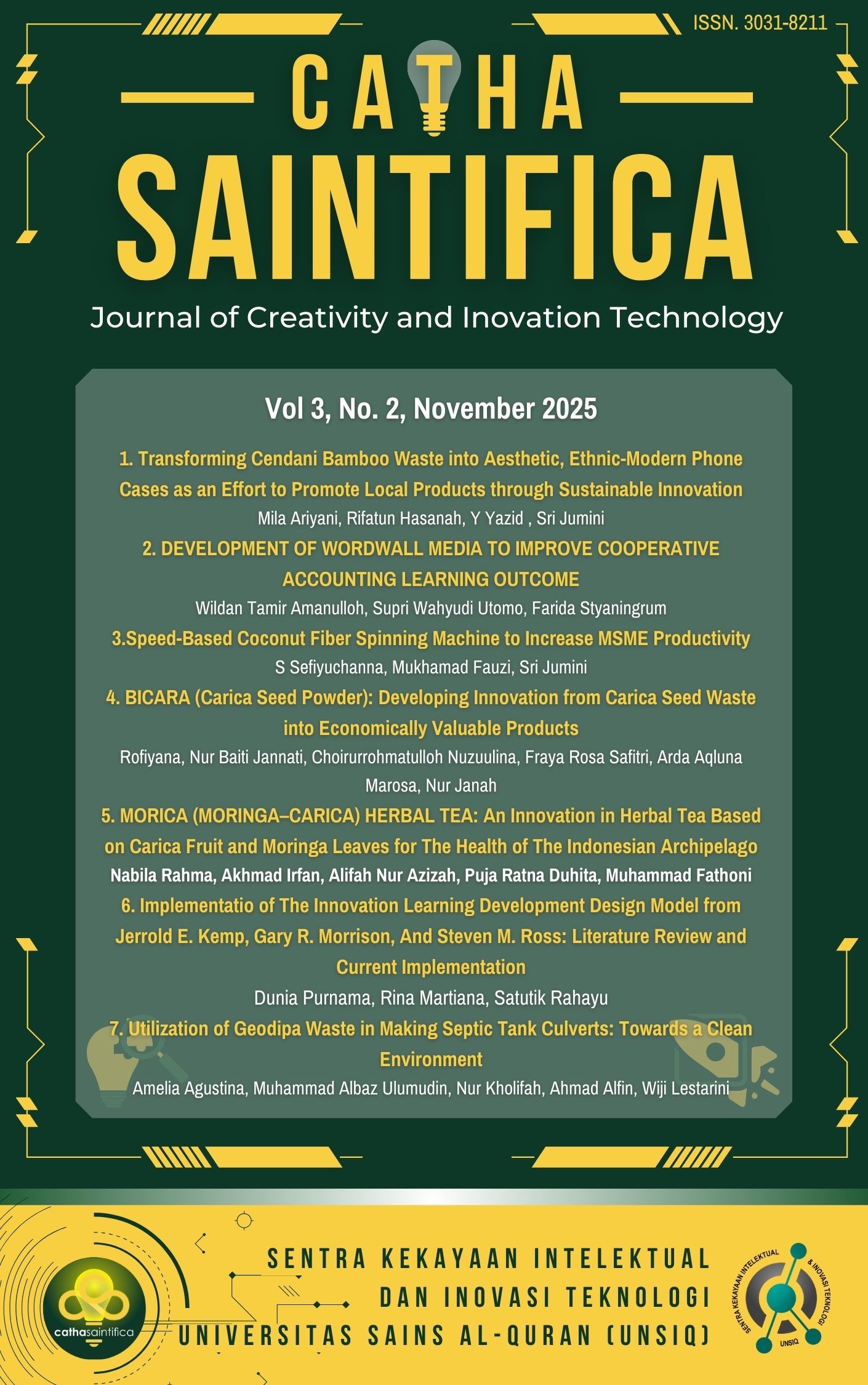
Development of WordWall Media to Improve Learning Outcomes
DOI:
https://doi.org/10.32699/cathasaintifica.v3i2.10163Keywords:
Learning Media, Learning Outcomes, SOLE, WordWallAbstract
One of the main challenges in vocational education, particularly in accounting learning, is students’ low understanding of basic accounting concepts. This study aims to develop WordWall-based learning media integrated with the Self-Organized Learning Environment (SOLE) model and to examine its effectiveness in improving learning outcomes on Cooperative Accounting material at SMK Negeri 5 Madiun City. The research employed a Research and Development approach using the ADDIE model, consisting of analysis, design, development, implementation, and evaluation stages. Data were collected through interviews, observations, questionnaires, and pretest–posttest learning outcome assessments. The developed WordWall media was validated by material, language, and media experts and met the feasibility criteria for classroom use. The implementation involved 30 students of class XI Accounting. Questionnaire results showed a feasibility and practicality score of 85.21%, categorized as feasible for implementation. Learning outcomes demonstrated a substantial improvement, with the average pretest score of 64 and learning completeness of 6.67% increasing to an average posttest score of 88 with 96.67% completeness after the use of the media. These findings indicate that WordWall media integrated with the SOLE model effectively enhances students’ understanding and mastery of Cooperative Accounting concepts.
.
References
Amril, Darniyanti, Y., & Sapitri, D. R. (2023). Development of Learning Media Using Wordwall in Science Subjects for Grade V Elementary School. Innovative: Journal of Social Science Research, 3(3), 9593–9607.
Fikri, M. I., & Amalia, N. (2022). The Effect of SOLE Learning Model on the Development of 21st Century Skills in Senior High School Students. Scientific Journal of Indonesian Language, Literature and Regional Education,12 (2), 147-155. https://www.journal.unpas.ac.id/index.php/literasi/article/view/4308
Hariana, F. D., Alawiyah, T., & Rahayu, F. (2024). Application of Web-Based Interactive Learning Media (Wordwall Net) in Increasing Student Learning Motivation in Mathematics Subjects in Class III. 43–48.
Lestari, S. R., Saleh, A. R., & Muchtar. (2023). The Use of Game-Based Learning Media Wordwall to Increase Motivation and Biology Learning Outcomes of Class XI High School Students. Journal of Learning Thought and Development, 5(20), 473–478.
Monigir, N., & Wakari, T. I. (2024). Increasing Student Active Participation with Wordwall Interactive Media. J-CEKI: Journal of Scientific Scholarship, 3(6), 7879–7887.
Nabilah, N. P., & Warmi, A. (2023). The Use of Web-based Learning Media Wordwall Games on Mathematics Learning Motivation in Class VIII SMPN 2 Jalancagak. Nusantara Journal of Community Service, 4(2), 1454–1464.
Ningrum, N. D. C., Faslah, R., & Wahono, P. (2024). Development of Wordwall-Based Interactive Learning Media in the Subject of Office Management Facilities and Infrastructure Class XI at SMK Tunas Pembangunan. Journal of Education and Teaching, 2(9), 714–722.
Novianti, N., Khaulah, S., & Rahma, R. (2022). The Effect of SOLE (Self Organized Learning Environment) Learning Model on Field Analytic Geometry Course. Scientific Journal of Mathematics Education Al Qalasadi,6 (2), 159-166. https://doi.org/10.32505/qalasadi.v6i2.4915
Paulus, C. S., Tengker, S. M. T., & Tuerah, J. M. (2023). Development of Wordwall Learning Media in Chemistry Lessons on Basic Laws of Chemistry at SMA Kr. Eben Haezar Manado High School. OXYGENIUS: Journal Of Chemistry Education,5 (2), 92-97. https://doi.org/10.37033/ojce.v5i2.582
Rafi'y, M., Ferry Irawan, & Dharma Gyta Sari Harahap. (2023). Development of Interactive Teaching Materials Based on Problem Based Learning to Improve Students' Science Literacy Skills. Indo-MathEdu Intellectuals Journal,4 (2), 669-682. https://doi.org/10.54373/imeij.v4i2.243
Roviani, S., Idrus, H., Umar, M. I. A., & Chandra, A. N. (2023). Application of SOLE (Self Organized Learning Environments) Learning Model on Learning Outcomes of Students of Class XI IPA SMA Negeri 1 Bukittinggi Assisted by Microsoft Teams Application. Edusainstika: Journal of Mathematics and Natural Sciences Learning,3 (1), 41. https://doi.org/10.31958/je.v3i1.9541
Rustandi, A., & Rismayanti. (2021). Application of the ADDIE Model in Learning Media Development at SMPN 22 Samarinda City. Fasilkom Journal,11 (2), 57-60. https://doi.org/10.37859/jf.v11i2.2546
Saputra, A. (2022). Islamic Religious Education Learning Evaluation Strategy in Junior High School. Genta Mulia: Scientific Journal of Education,13(2), 73–83. https://ejournal.stkipbbm.ac.id/index.php/gm/article/view/861%0Ahttps://ejournal.stkipbbm.ac.id/index.php/gm/article/download/861/811
Setiawan, H. R., Rakhmadi, A. J., & Raisal, A. Y. (2021). Development of Teaching Media for Black Holes Using the Addie Development Model. Journal of Physics Coils,4 (2), 112-119. https://doi.org/10.33369/jkf.4.2.112-119
Wiriani, W. T. (2021). The Effect of Learning Independence on Student Learning Outcomes in Online Learning. Scientific Journal of Realistic Mathematics,2 (1), 57-63. https://doi.org/10.33365/ji-mr.v2i1.436
Downloads
Published
Issue
Section
License
Copyright (c) 2025 Wildan Tamir Amanulloh, Supri Wahyudi Utomo, Farida Styaningrum

This work is licensed under a Creative Commons Attribution-ShareAlike 4.0 International License.
_(1).png)