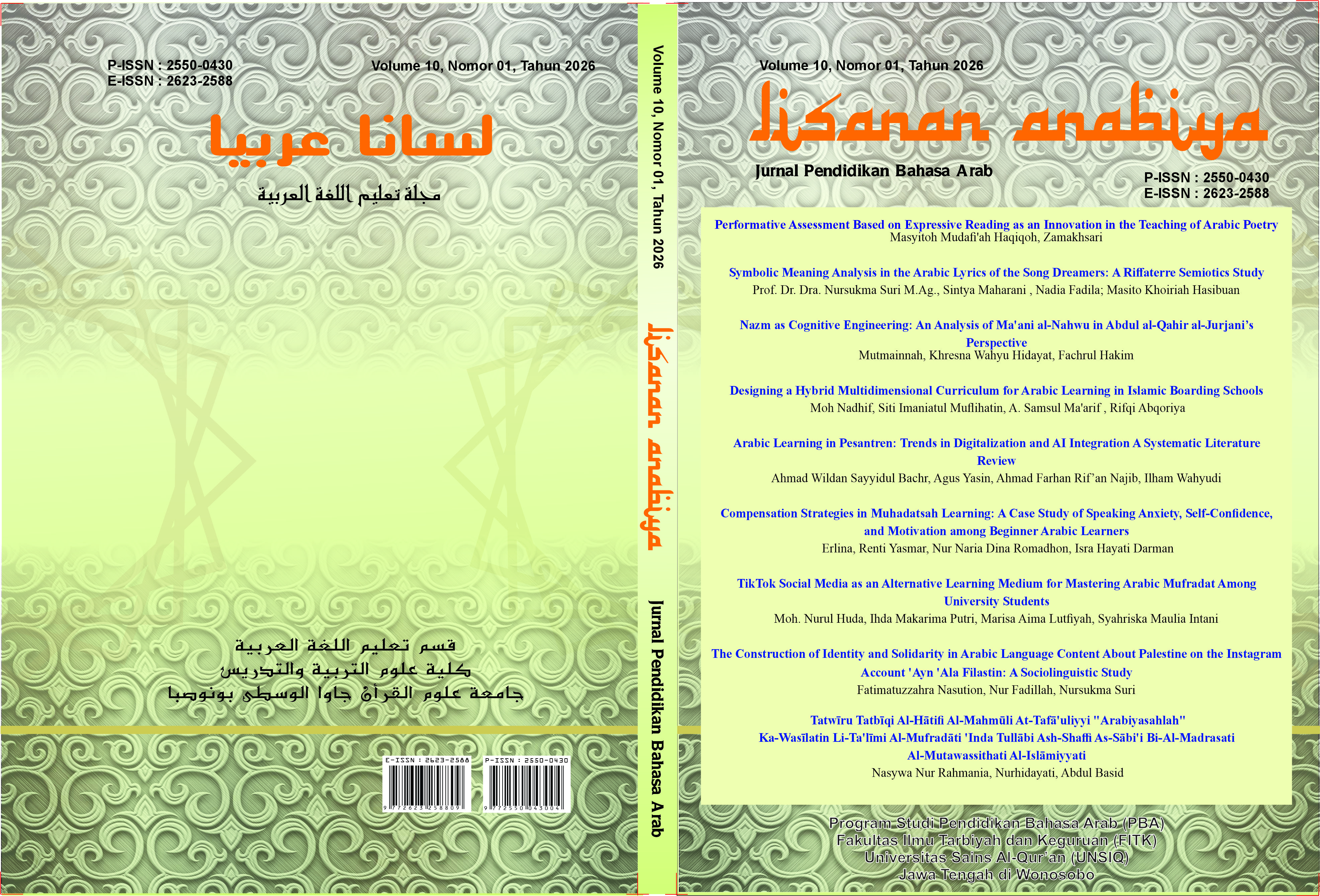
Arabic Learning in Pesantren: Trends in Digitalization and AI Integration A Systematic Literature Review
DOI:
https://doi.org/10.32699/3ks80b86Keywords:
Arabic Language Learning, Pesantren (Islamic Boarding Schools), Digitalization, Artificial Intelligence, Systematic Literature ReviewAbstract
This study examines the trends and patterns of digital media and artificial intelligence integration in Arabic language learning within pesantren contexts. Using a systematic literature review approach guided by PRISMA procedures, it analyzes 20 selected articles published between 2016 and 2026 from major academic databases. The findings reveal a growing use of digital and AI-based media to enhance learner engagement, motivation, and access to diverse learning resources, particularly in receptive skills such as listening and reading. Theoretically, these practices align with Computer-Assisted Language Learning (CALL) and constructivist learning theory, emphasizing interaction, autonomy, and active knowledge construction. However, several limitations persist, including short-term implementations, limited integration of multiple language skills, and the tendency to use technology as a supplementary rather than pedagogically grounded tool. This study contributes by providing a structured synthesis of current research trends and identifying critical gaps in the use of digital and AI-based media in pesantren settings. The findings highlight the need for more comprehensive, integrative, and longitudinal research to develop pedagogically sound and contextually relevant approaches to Arabic language learning.
References
Abdelhamid, I Y, H Yahaya, and H N Shaharuddin. 2023. “Assessing the Impact of Gamification on Academic Achievement and Student Perceptions of Learning Arabic Grammar: A Quasi-Experimental Study.” International Journal of Academic Research in Business and Social Sciences 13 (5): 760–73. https://doi.org/10.6007/IJARBSS/v13-i5/16862.
Abdelrehim, Mohamed, Ghada Salih, Khaled Shaalan, and Azza Basiouni. 2026. “Evaluating the Educational and Cultural Risks of Generative AI Videos in Arabic Learning Contexts.” Procedia Computer Science 275: 733–42. https://doi.org/https://doi.org/10.1016/j.procs.2026.01.085.
Agung, Husnaini Jamil & Nur. 2022. “Tantangan Pembelajaran Bahasa Arab Di Era Society 5.0: Analisis Pembelajaran Bahasa Arab Berbasis Aplikasi Interaktif.” Alibbaa’: Jurnal Pendidikan Bahasa Arab 3 (1): 38–51. https://doi.org/https://doi.org/10.19105/ajpba.v3i1.5536.
Ahmad Mustofa, Amin, Setiyadi Alif Cahya, Najib Ahmad Farhan Rif’an, Imron Ali, and Utomo Wahyu Cahyo Budi. 2025. “Fa‘Āliyat Istikhdām Al-Wasā’Iṭ Al-Ta‘līmīyah Al-Sam‘īyah Al-Baṣarīyah Fī Ta‘līm Tamrīn Al-Lughah Al-‘Arabīyah.” Al-Ma’rifah 22 (1): 103–16. https://doi.org/10.21009/almakrifah.22.01.08.
Alsayed, A, M Arif, T M Qadah, and S Alotaibi. 2023. “A Systematic Literature Review on Using the Encoder-Decoder Models for Image Captioning in English and Arabic Languages.” Applied Sciences (Switzerland) 13 (19). https://doi.org/10.3390/app131910894.
Arifin, Zainul, Ayu Desrani, Apri Wardana Ritonga, and Faishol Mahmoud Adam Ibrahim. 2023. “An Innovation in Planning Management for Learning Arabic at Islamic Boarding Schools.” Nidhomul Haq: Jurnal Manajemen Pendidikan Islam 8 (1): 77–89. https://doi.org/10.31538/ndh.v8i1.3237.
Arisandi, Yusuf, and Moh Tohiri Habib. 2025. “Optimizing YouTube for Interactive Arabic Learning in Pesantren: Effective Content Creation Strategies.” International Journal of Arabic Language Teaching 7 (02): 239–54. https://doi.org/10.32332/ijalt.v7i02.10363.
Arrahma, Nabila. 2025. “Dampak Inovasi Media Pembelajaran Terhadap Minat Dan Hasil Belajar Bahasa Arab Siswa MTsS Ummi Lubuk Pakam.” Jurnal Penelitian Pendidikan Indonesia (JPPI) 2 (2): 353–62.
Azka, Lulu, Ummi Nur Hafsoh, and Faishol Mahmoud Adam Ibrahim. 2024. “The Challenges of Learning Arabic Listening Skills Using Youtube as a Learning Tool.” Alsina: Journal of Arabic Studies 6 (2): 229–46. https://doi.org/10.21580/alsina.6.2.23369.
Bagus, Sanjaya M, M. F. R Nasution, A. D Maulana, and S. Nasution. 2024. “Mengoptimalkan Media Teknologi Dalam Pembelajaran Bahasa Arab: Analisis Tantangan Dan Peluang Di Era Digital.” Jurnal Nirta : Studi Inovasi 4 (1): 54–70. https://www.ejournal.nlc-education.or.id/index.php/JNSI/article/view/99.
Cabrera, Derek, and Laura L Cabrera. 2023. “The Steps to Doing a Systems Literature Review (SLR).” Journal of Systems Thinking Preprints. https://www.scienceopen.com/document/read?vid=9df9896c-6ded-4b5a-8933-ff6af748328b.
Dewi, Bela Noviana. 2022. “Media Film Untuk Pembelajaran Maharah Istima’ Di Pondok Pesantren Modern Gontor Putri: Implementasi Dan Analisis Respon Santriwati.” Alibbaa’: Jurnal Pendidikan Bahasa Arab 3 (2): 124–40. https://doi.org/https://doi.org/10.19105/ajpba.v3i2.6176.
Dodi, Mulyadi, Wijayatiningsih Testiana Deni, and Prastikawati Charanjit Kaur Swaran, Singh Entika Fani. 2021. “Effects of Technology Enhanced Task-Based Language Teaching on Learners’ Listening Comprehension and Speaking Performance.” ERIC: International Journal of Instruction 14 (3): 717–36. https://eric.ed.gov/?id=EJ1304552.
Fadlelmula, F K, and S M Qadhi. 2024. “A Systematic Review of Research on Artificial Intelligence in Higher Education: Practice, Gaps, and Future Directions in the GCC.” Journal of University Teaching and Learning Practice 21 (6). https://doi.org/10.53761/pswgbw82.
Firmansyah, Deri, and Dede. 2022. “Teknik Pengambilan Sampel Umum Dalam Metodologi.” Jurnal Ilmiah Pendidikan Holistik (JIPH) 1 (2): 85–114. https://doi.org/10.55927/jiph.v1i2.937.
Hamid, Mas’an, Muhammad Alfa Choirul Murtadho, Ahmad Yanif Firdaus, and Masturi Masturi. 2024. “Language Environment and Acquisition Dynamics of Arabic in Pesantren: Perspectives on Islamic Education and Learning Tradition.” International Journal of Islamic Thought and Humanities 3 (2): 387–400. https://doi.org/10.54298/ijith.v3i2.608.
Hamka, Nur Ramadhani, and Syarifah Fatimah Susiawati. 2024. “Wordwall Learning Media for Online Arabic Vocabulary Learning for High School Students.” Pinisi Journal of Education 4 (4): 24–35. https://journal.unm.ac.id/index.php/PJE/article/view/3220.
Hasbi, Anang Fajar. 2025. “Methods, Challenges, and Strategies for Learning Arabic Reading Skill: : A Systematic Literature Review.” Madah: Jurnal Bahasa Dan Sastra 16 (1): 110–125. https://doi.org/10.31503/madah.v16i1.993.
Hasim, Muhamad Fuad, Muhammad Baihaqi, Nelly Sakinah, Ulil Irzaqotul Humaidah, and Adi Surya Utama. 2025. “Bridging Assessment and Proficiency: Developing Speaking Skill Test Instruments for Arabic Learners.” Tsaqofiya: Jurnal Pendidikan Bahasa Dan Sastra Arab 7 (2): 526–37. https://doi.org/10.21154/zk6nbg28.
Hijriyah, U, R N Edi, M Aridan, H U Hashim, and G C Kesuma. 2025. “How Effective Is SUNO.AI in Enhancing Arabic Listening Skills? An Evaluation of AI-Based Personalized Learning.” International Journal of Information and Education Technology 15 (2): 391–407. https://doi.org/10.18178/ijiet.2025.15.2.2251.
Hinderks, Andreas, Francisco José Dom’inguez Mayo, Jörg Thomaschewski, and Mar’ia José Escalona. 2020. “An SLR-Tool: Search Process in Practice: A Tool to Conduct and Manage Systematic Literature Review (SLR).” In Proceedings of the ACM/IEEE 42nd International Conference on Software Engineering: Companion Proceedings, 81–84. ICSE ’20. New York, NY, USA: Association for Computing Machinery. https://doi.org/10.1145/3377812.3382137.
Huda, M, Z Haron, M N Ripin, A Hehsan, and A B C Yaacob. 2017. “Exploring Innovative Learning Environment (ILE): Big Data Era.” Int J Appl Eng Res 12.
Hussein, M H, S H Ow, A Al-Azawei, and I Ibrahim. 2022. “What Drives Students’ Successful Reuse of Online Learning in Higher Education? A Case of Google Classroom.” Australasian Journal of Educational Technology 38 (3): 1–21. https://doi.org/10.14742/ajet.7335.
Idhan, M, M Jabir, R Ruslin, M N Asmawi, B Arafah, U Ubadah, U Ubay, and F Fatima. 2026. “Teachers’ Experiences With Mobile Apps for Arabic Language Learning: Insights From Islamic Schools in Palu, Indonesia.” Journal of Language Teaching and Research 17 (1): 338–50. https://doi.org/10.17507/jltr.1701.34.
Joanne E, McKenzie, Bossuyt Patrick M, Boutron Isabelle, Hoffmann Tammy C, Mulrow Cynthia D, Shamseer Larissa, Tetzlaff Jennifer M, and David Moher. 2021. “Updating Guidance for Reporting Systematic Reviews: Development of the PRISMA 2020 Statement.” Journal of Clinical Epidemiology 134: 103–12. https://doi.org/https://doi.org/10.1016/j.jclinepi.2021.02.003.
Lazuardi, Achmad Makki, Nur Hanifansyah, Menik Mahmudah, and Iqmal Wahyudi. 2025. “Enhancing Arabic Writing and Literacy through Ibda’Magazine: A Culturally Relevant Medium in Islamic Boarding Schools.” Kalamuna: Jurnal Pendidikan Bahasa Arab Dan Kebahasaaraban 6 (2): 370–85. https://doi.org/10.52593/klm.06.2.10.
Lu, Dan. 2022. “Validity Research of Interactive Audio-Visual English Learning Software in Language Input and Output.” In International Conference on Distance Education and Learning, 1–5. https://doi.org/10.1145/3543321.3543322.
Ma’Mun, T N, A Kosasih, Y Rohmayani, E K Fimansyah, and M H Al-Khresheh. 2021. “Foreign Language Teachers’ Technological and Pedagogical Content Knowledge: A Study with AFL Teachers in Indonesia.” Journal of Language and Linguistic Studies 17 (4): 1998–2021. https://doi.org/10.52462/jlls.145.
Mangaroo-Pillay, Mia, and Rojanette Coetzee. 2022. “Lean Frameworks: A Systematic Literature Review (SLR) Investigating Methods and Design Elements.” Journal of Industrial Engineering and Management; Vol 15, No 2 (2022). https://doi.org/10.3926/jiem.3677.
Masaji, Lalu, Ahmad Sirfi Fatoni, and Mohamed Mohi El-Din Ahmad. 2025. “Muthola’ah Learning in Pesantren: Improving Learning Outcomes through Visual Media.” Tsaqofiya: Jurnal Pendidikan Bahasa Dan Sastra Arab 7 (2): 378–94. https://doi.org/10.21154/2v3cgs14.
Maulidi, Maulidi, and Aufia Aisa. 2023. “Desain Pengembangan Buku Ajar Bahasa Arab Berbasis Permainan Edukatif Gramatikal Bahasa Arab.” Al-Lahjah: Jurnal Pendidikan, Bahasa Arab, Dan Kajian Linguistik Arab 6 (2): 1–8. https://doi.org/10.32764/allahjah.v6i2.2948.
Mearaj, Ijlal Saja, Syaza Marina Ramli, Anuar Sopian, and Abdul Qayyum Abdul Razak. 2021. “THE USE OF YOUTUBE IN ARABIC SPEAKING SKILLS DURING OPEN AND DISTANCE LEARNING (ODL).” E-Bangi: Journal of Sciences and Humanities 18 (4): 188–202. https://journalarticle.ukm.my/17729/1/49017-159089-1-SM.pdf.
Mustafa, M. 2023. “Pengembangan Media Interaktif Digital Untuk Pembelajaran Bahasa Arab.” Sinestesia.
Muthoifin, M, and M Elbanna. 2026. “Arabic Language Learning in Religious Contexts: Challenges and Opportunities.” International Journal of Society, Culture and Language 14 (1): 95–113. https://doi.org/10.22034/ijscl.2025.2076763.4249.
Najib, Ahmad Farhan Rif’an, Agus Cahyo Setiyadi, Imam Mahmudi, and Luthfi Muhyiddin. 2025. “Wordwall Game as an Interactive Medium in Arabic Vocabulary Acquisition for Novice Learners.” Jurnal Al Bayan: Jurnal Jurusan Pendidikan Bahasa Arab 17 (2): 483–501. https://doi.org/10.24042/ewqxn123.
Özdemir, Osman. 2025. “Kahoot! Game-Based Digital Learning Platform: A Comprehensive Meta-Analysis.” Journal of Computer Assisted Learning 41 (1): 1–24. https://doi.org/https://doi.org/10.1111/jcal.13084.
Paul, Justin, Weng Marc Lim, Aron O’Cass, Andy Wei Hao, and Stefano Bresciani. 2021. “Scientific Procedures and Rationales for Systematic Literature Reviews (SPAR-4-SLR).” International Journal of Consumer Studies 45 (4): O1–16. https://doi.org/https://doi.org/10.1111/ijcs.12695.
Prastiwi, Arum Triasning, Dewi Masruroh, and Reza Hasbullah Rumbaroa. 2021. “Optimizing Google Classroom , Google Form and Zoom in Arabic Learning at Al-Azhar Islamic Boarding School Yogyakarta.” ALSUNIYAT: Jurnal Penelitian Bahasa, Sastra, Dan Budaya Arab 4 (2): 95–109. https://doi.org/10.17509/alsuniyat.v4i2.32300.
Price, A., Beckey, A., & Collins, D. 2024. “Developing a Love for Playing Games: A Clarification of Why Digital Video Games Approach Is Not Gamification.” Physical Education and Sport Pedagogy 29 (6): 558–72. https://doi.org/https://doi.org/10.1080/17408989.2022.2125946.
Putri, Syifa Firdausi, M Wahyudi, Ahmad Farhan Rif’an Najib, and S A Nur Azizah. 2025. “Aṡar Al-Yūtyūb Kawasīlah Ta‘līmiyyah Tafā‘uliyyah Fī Tanmiyyah Mahārah Al-Kalām Ladā Ṭullāb Al-Marḥalah Al-Mutawassiṭah.” Aphorisme: Journal of Arabic Language, Literature, and Education 6 (1): 636–48. https://doi.org/10.37680/aphorisme.v6i1.7754.
Qasserras, Lhoussine. 2023. “Systematic Review of Communicative Language Teaching (CLT) in Language Education: A Balanced Perspective.” European Journal of Education and Pedagogy 4 (6): 17–23. https://doi.org/10.24018/ejedu.2023.4.6.763.
Rahmi, Wiza Novia, and Asti Nazhyfa. 2024. “EDUCATIONAL TRANSFORMATION: FROM BOARDING SCHOOL TO PESANTREN WITH BI’AH ARABIYYAH.” Al-Masail: Journal of Islamic Studies 2 (1): 49–60. https://doi.org/10.61677/al-masail.v2i1.130.
Ritonga, M, A Mudinillah, W Wasehudin, J Julhadi, A Amrina, and M H Shidqi. 2024. “The Effect of Technology on Arabic Language Learning in Higher Education.” Journal of Education and Learning 18 (1): 116–27. https://doi.org/10.11591/edulearn.v18i1.20867.
Ritonga, Mahyudin, Adam Mudinillah, Muhammad Zalnur, and Fauzul Fil Amri. 2023. “Learning Arabic for Kids Online Using Google Classroom.” In: Yafooz, W.M.S., Al-Aqrabi, H., Al-Dhaqm, A., Emara, A. (Eds) Kids Cybersecurity Using Computational Intelligence Techniques. Studies in Computational Intelligence 1080 (Springer, Cham): 155–63. https://doi.org/10.1007/978-3-031-21199-7_11.
Ritonga, Mahyudin, Sobhan Sobhan, Bambang Bambang, and Safi Khadidja. 2022. “Utilizing Technology to Improve the Quality of Learning in Indonesia: Challenges and Consequences for Arabic Teachers.” Arabiyat: Jurnal Pendidikan Bahasa Arab Dan Kebahasaaraban 9 (1): 56–68. https://doi.org/10.15408/a.v9i1.24516.
Rusady, A. T., & Gumliar, R. 2024. “Development of an Arabic Writing Skills Textbook Based on Collocations.” Research and Development in Education (RaDEn) 4 (2): 1030–42. https://doi.org/https://doi.org/10.22219/raden.v4i2.36229.
Sarah, S, A Rizqia, L Lisna, and M Ali. 2024. “Technology Integration in Arabic Language Skills Development in the Digital Era.” Al-Fusha : Arabic Language Education Journal 6 (2): 74–81. https://doi.org/https://doi.org/10.62097/alfusha.v6i2.1735.
Sardiyanah, Husnaini Jamil dan. 2020. “Tantangan Pembelajaran Bahasa Arab Di Era Society 5.0: Analisis Pembelajaran Bahasa Arab Berbasis Aplikasi Interaktif.” NASKHI: Jurnal Kajian Pendidikan Dan Bahasa Arab 2 (1): 30–39. https://doi.org/https://doi.org/10.47435/naskhi.v2i1.289.
Setiyadi, A. C., Anhar, A., & Muttaqin, H. 2025. “Utilizing Comics as a Learning Media to Improve Students’ Arabic Speaking Skills.” Arabiyatuna: Jurnal Bahasa Arab 9 (1): 43–66. https://doi.org/https://doi.org/10.29240/jba.v9i1.12211.
Setiyadi, Alif Cahya, Anhar Anhar, and Hasan Muttaqin. 2025. “Utilizing Comics as a Learning Media to Improve Students’ Arabic Speaking Skills.” Arabiyatuna: Jurnal Bahasa Arab 9 (1): 43–66. https://doi.org/10.29240/jba.v9i1.12211.
Setiyono, Nabella Angellita. 2025. “A Comparative Study of the Effectiveness of Using Traditional and Digital Learning Media.” International Journal of Law Social Sciences and Management 2 (1). https://doi.org/10.69726/ijlssm.v2i1.87.
Shamsi, Esmat, and Hossein Bozorgian. 2024. “Collaborative Listening Using Multimedia through Metacognitive Instruction: A Case Study with Less-Skilled and More-Skilled EFL Learners.” Asian-Pacific Journal of Second and Foreign Language Education 9 (1): 25. https://doi.org/10.1186/s40862-023-00248-8.
Siregar, Sri Dewi Priwarti, Mohamad Zaka Al Farisi, Asep Sopian, Nurul Isra Hardin, Mennatallah Mohamed Hassan El-Sabagh, and Ramadhan Safrudin. 2025. “Arabic Writing Skills Teaching Materials Based on Graphemics for Autistic Students.” Asian Education and Development Studies 14 (3): 495–517. https://doi.org/https://doi.org/10.1108/AEDS-08-2024-0171.
Solehudin, Muhamad, Nur Hanifansyah, and Iqbal Fathi Izzuddin. 2024. “Enhancing Arabic Listening and Vocabulary Acquisition through AI-Powered Music: A Study on Suno AI.” Arabiyat: Journal of Arabic Education & Arabic Studies 11 (2): 175–88. https://doi.org/10.15408/a.v11i2.41994.
Suhartono, Entot. 2017. “Systematic Literatur Review (SLR): Metode, Manfaat, Dan Tantangan Learning Analytics Dengan Metode Data Mining Di Dunia Pendidikan Tinggi.” Jurnal Ilmiah INFOKAM 13 (1). https://doi.org/10.53845/infokam.v13i1.123.
Suja, A, K Anwar, M Khuluq, and L Eka Retnaningsih. 2025. “Islamic Kindergarten Teachers’ Beliefs about Early Arabic Learning in the Indonesian Context: Advantaged Learning, Teacher’s Ability, and Their Methods in Teaching Arabic.” Journal of Early Childhood Teacher Education. https://doi.org/10.1080/10901027.2025.2581022.
Sunarko, Asep, Muhamad Solehudin, and Nurin Sakinah. 2026. “Elevenlabs Text-To-Speech and Arabic Listening Achievement in Pesantren.” An Nabighoh 28 (1): 1–20. https://doi.org/10.32332/an-nabighoh.v28i1.1-20.
Syafei, Isop, Eman Suleman, and Robanda Robanda. 2024. “The Development of Student Reading Skills in Arabic for Reading Islamic Classical Books Using the Arabic Learning Model at Indonesian Islamic Boarding Schools.” Theory and Practice in Language Studies 14 (5): 1381–92. https://doi.org/10.17507/tpls.1405.10.
Syaifullah, Muhammad, Siti Mubarokah, Nailul Izzah, Wakhidati Nurrohmah Putri, Kholida Nur, and Syuhadak Syuhadak. 2023. “The Media Thematic Dictionary and Its Application in Improving Speaking Skills l Wasa’il Al-Qamus Al-Maudhu ‘i Wa Tathbiqu Fi Tarqiyati Maharah Al-Kalam.” Jurnal Al Bayan: Jurnal Jurusan Pendidikan Bahasa Arab 15 (2): 432–53. https://doi.org/10.24042/albayan.v15i2.15524.
Taufiqurrochman, R. 2025. “Linking Environmental Education and Arabic Language Teaching: Curriculum Analysis of Madrasa and Pesantren in Indonesia.” Studia Ecologiae et Bioethicae 23 (2): 73–85. https://doi.org/10.21697/seb.2024.5845.
Tseng, Y.-C., and Y.-H. Lin. 2026. “Enhancing Digital Competency in EFL Teacher Education: Investigating Graduate-Level Student Teacher’s Design and Implementation of Digital Materials.” Research and Practice in Technology Enhanced Learning 21 (12): 1–27. https://doi.org/10.58459/rptel.2026.21012.
Ubaidillah, Ubaidillah, Muhamad Muflih, Nurul Fajri, Hambali Jaili, and Nikmatun Azimah. 2023. “The Importance of Digital Media in Arabic Language Learning; The Use of Canva in Vocabulary Learning.” Jurnal Al-Maqayis 10 (1): 36–52. https://doi.org/10.18592/jams.v10i1.8675.
Windawati, Ririn, and Henny Dewi Koeswanti. 2021. “Pengembangan Game Edukasi Berbasis Android Untuk Meningkatkan Hasil Belajar Siswa Di Sekolah Dasar.” Jurnal Basicedu 5 (2): 1027–38. https://doi.org/10.31004/basicedu.v5i2.835.
Yasin, Agus, Marheni Br Maha, Ahmad Hidayatullah Zarkasyi, Siti Anne Barkah Nur Fauziah, and Ahmad Zalzuli. 2023. “Development of the" Al-Muhdastah Al-Yaumiyyah" Textbook to Improve Arabic Speaking Skills at an Islamic Boarding School.” Izdihar: Journal of Arabic Language Teaching, Linguistics, and Literature 6 (2): 141–52. https://doi.org/10.22219/jiz.v6i2.22695.
Yasin, Agus, Tiara Eki Wahyu Rinawati, and Nabila Rahayu Putri. 2025. “Using Kahoot Application as Interactive Media in the Arabic Speaking Skills Development.” Arabiyat: Journal of Arabic Education & Arabic Studies/Jurnal Pendidikan Bahasa Arab Dan Kebahasaaraban 12 (1): 99–111. https://doi.org/10.15408/a.v12i1.41276.
Yoke, Suryadarma, Aldini Arifandhy, Pradhana Faisal Reza, and Yani Ahmad. 2024. “Implementation of Video Animation to Increase the Interest and Result of Students in Muthala’ah at Islamic Boarding School.” ALSUNIYAT: Jurnal Penelitian Bahasa, Sastra, Dan Budaya Arab 7 (1): 58–76. https://ejournal.upi.edu/index.php/alsuniyat/article/view/67141.
Zulpina, Zulpina, Achmad Makki Lazuardi, Nur Hanifansyah, and Kamaluddin Nurdin Marjuni. 2025. “Strategic Utilization of Ibda’Magazine as an Innovative Instructional Medium to Enhance Students’ Arabic Reading Skills.” An Nabighoh 27 (1): 101–22. https://doi.org/10.32332/an-nabighoh.v27i1.101-122.
Downloads
Published
Issue
Section
License
Copyright (c) 2026 Ahmad Wildan Sayyidul Bachr, Agus Yasin, Ahmad Farhan Rif’an Najib, Ilham Wahyudi

This work is licensed under a Creative Commons Attribution-ShareAlike 4.0 International License.
Authors who publish with this journal agree to the following terms:
a. Authors retain copyright and grant the journal right of first publication with the work simultaneously licensed under a Creative Commons Attribution-ShareAlike 4.0 International License. that allows others to share the work with an acknowledgement of the work's authorship and initial publication in this journal.
b. Authors are able to enter into separate, additional contractual arrangements for the non-exclusive distribution of the journal's published version of the work (e.g., post it to an institutional repository or publish it in a book), with an acknowledgement of its initial publication in this journal.
c. Authors are permitted and encouraged to post their work online (e.g., in institutional repositories or on their website) prior to and during the submission process, as it can lead to productive exchanges, as well as earlier and greater citation of published work (See The Effect of Open Access).


_(1).png)