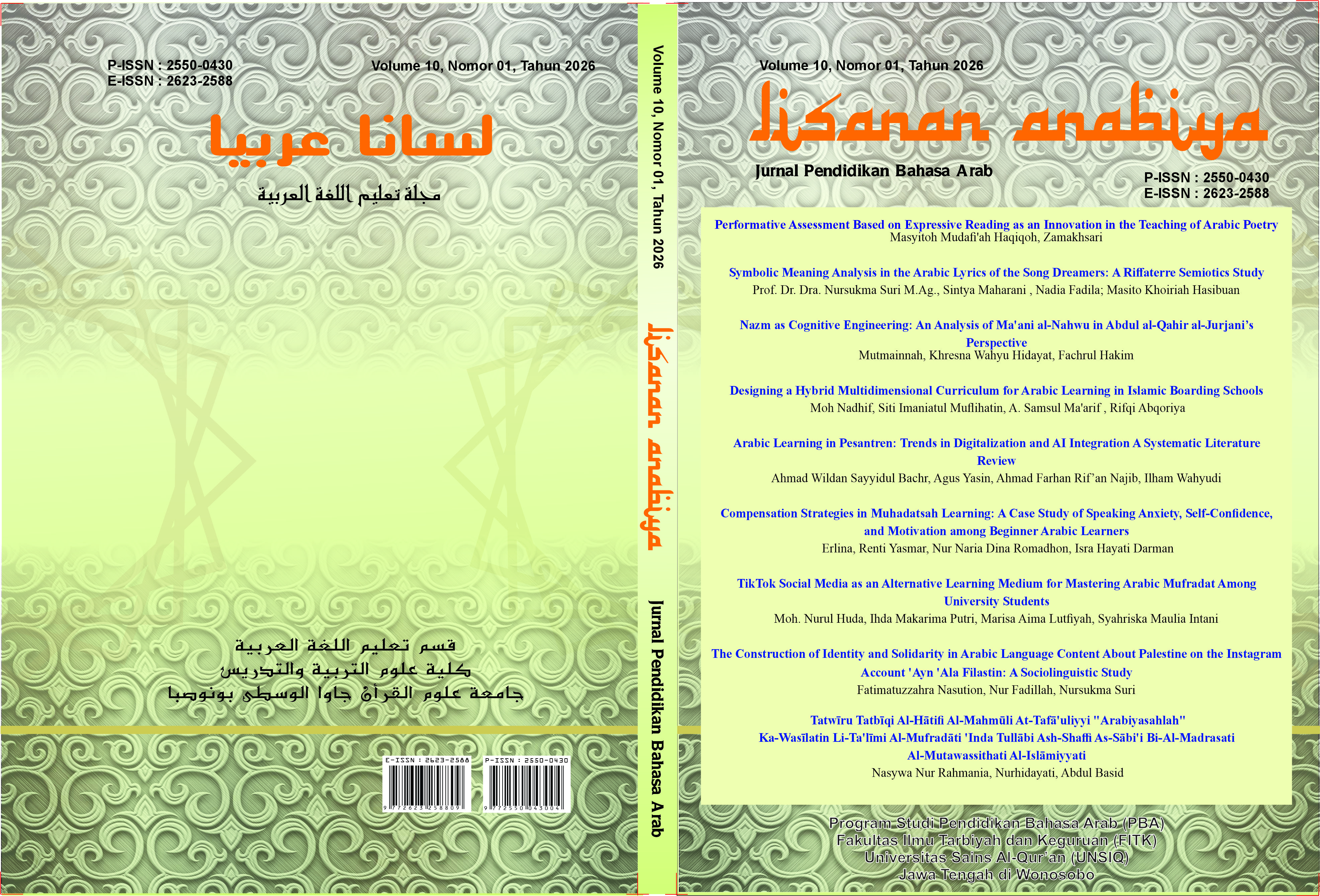
Nazm sebagai Rekayasa Kognitif: Telaah Ma'ani an-Nahwu Abdul Qahir al-Jurjani dalam QS. Al-'Alaq 1–5
DOI:
https://doi.org/10.32699/drt4ev45Kata Kunci:
Nazm Theory, Qur'anic Rhetoric, Surah Al-'Alaq, Islamic Epistemology, Library StudyAbstrak
This study aims to reconstruct the rhetorical understanding of Surah Al-'Alaq verses 1–5, which is often trapped in the dichotomy of literal and esoteric interpretations, using the theoretical framework of Nazm by Abdul Qahir al-Jurjani. This research employs a qualitative approach with a library research design. Data were collected using documentation techniques sourced from the primary text of the Qur'an and the book Dala'il al-I'jaz. The analysis uses Nazm-based content analysis to examine the syntactic architecture of the verses. The findings reveal that the syntactic architecture of the verses—such as the fronting of verbs and the omission of objects—is not merely a stylistic ornament but an instrument of cognitive engineering. This structure integrates intellectual validity with spiritual awareness, building an epistemological foundation that fundamentally rejects intellectual arrogance. Ideally, Islamic education curricula and digital da'wah strategies should be reoriented to go beyond textual reading towards holistic and transformative structural meaning.
Referensi
Abdussamad, Z. (2021). Metode Penelitian Kualitatif. Syakir Media Press.
Al Jurjani, A. B. A. Q. bin A. R. (2004). Dalailul i'jaz. Maktabah al Khaniji.
Al-Jurjani, A. Q. bin A. R. (1331). Dalail al-I'jaz. Mathba'ah al-Manar.
Arif, M. (2016). Hermeneutika Al-Qur'an Dr. Ali Abdul Halim Mahmud (w. 2014) Dalam Mengembangkan Tafsir Pendidikan Islam. Jurnal Pendidikan Agama Islam, 13(1).
Arsyad, B. (2025). Iltifat dalam Al-Qur'an: Analisis Semantik–Retoris Surah al-Baqarah dan Ali 'Imran. Jurnal Pendidikan Bahasa Arab dan Kebahasaaraban, 4(1).
Atabik, A. (2021). Al-Nazm Stylistic Discourse in I'jaz Al-Qur'an Based on Al-Jurjani's Perspective: Analysis of Arabic Literature Criticism on the Qur'an Studies. Ulumuna, 25(1).
Azis, A., Umyanah, Y., & Mukhtar, H. (2025). Keindahan Retorika dalam Al-Qur'an: Analisis Balaghah dalam Ayat-ayat Persuasif. Uktub: Journal of Arabic Studies, 5(1).
Basyari, A. I. (2025). Menelusuri Bahasa Al-Qur'an (antara Dialek Suku Dan Bahasa Sastra Antar-Suku). Jurnal Media Akademik, 3(7).
Chandra, T. U., & Putra, A. M. (2025). Urgensi Literasi Sejak Dini: Telaah Nilai Edukatif QS. Al-'Alaq [96]:1-5. IKLILA: Jurnal Studi Islam dan Sosial, 4(1).
Dunggio, R., Saleh, S. R., Pakaya, N. A., & Arsyad, B. (2025). Analisis Sintaktis Dan Retoris Struktur Taqdim Al-Khabar Dalam Juz Ke-28 Al-Qur'an. Ajamiy: Jurnal Bahasa dan Sastra Arab, 14(2).
Fahmi, M. Z., Ihsan, M., Handayani, R., Simbolon, P., Rahayu, F., Hanafi, M., & Ariza, F. N. (2025). Memahami Pesan Al-Qur'an Lebih Dalam: Aplikasi Retorika Balaghah Untuk Peningkatan Literasi Keagamaan Masyarakat Sebuah Pendekatan Konseptual. Journal of Community Engagement, 4(1).
Fitriansyah, M. B., Imam, J. S. N., Komarudin, E., & Taufiq, W. (2025). Estetika Makna dalam Komunikasi Al-Qur'an: Studi Stilistika atas Muhassinat Ma'nawiyyah dalam Ayat-Ayat Sosial. Jurnal Syntax Imperatif: Jurnal Ilmu Sosial dan Pendidikan, 6(3).
Ghozali, M. (2020). Linguistic Relativity al-Qur'an: Nalar I'jaz dalam Pandangan Abd al-Qahir al-Jurjani. MAGHZA: Jurnal Ilmu Al-Qur'an dan Tafsir, 5(2).
Hami, W. (2024). Kontekstualisasi Makna Pendidikan Dalam Al-Qur'an Perspektif Hermeneutika Abdullah Saeed. Al-nizam: Indonesian Journal of Research and Community Service, 2(2).
Hariyati, C. S., Hasibuan, T. A., Fathansyach, E. D., & Alrasyid, H. (2024). Keunikan Struktur Bahasa Al-Qur'an Dalam Analisis I'jaz Al-Bayan. HUMANITIS: Jurnal Humaniora, Sosial dan Bisnis, 2(7).
Hrp, N. A., & Putri, A. (2025). Perkembangan dan Landasan Teori Ilmu Balaghah dalam Keindahan Kebahasaan Al-Qur'an. Al-Iftah: Jurnal Tafsir Al-Qur'an dan Hadist, 3(1).
Mustaghfiroh, A. A., & Suryadilaga, M. A. (2021). Telaah Sosiologi Pengetahuan Terhadap Konteks Pewahyuan Al-Qur'an Dan Pengilhaman Bibel. Al-Dhikra: Jurnal Studi Qur'an & Hadis, 3(2).
MZ, A. M., Mujab, M. S., & Syahputra, S. T. (2023). Tafsir Pendidikan Islam dalam Tafsir Al-Burhan Karya Abdul Karim Amrullah (Analisis QS. Al-'Alaq: 1-5). Jurnal Pendidikan Islam, 4(1).
Mz, A. M., & Syahputra, S. T. (2023). Ajaran Pendidikan Islam dalam Tafsir Al-Burhan Karya Abdul Karim Amrullah (Analisis QS. Al-'Alaq: 1-5). I ICQS: International Conference on Quranic Studies, 1.
Nadhiroh, W. (2016). Fahm Al-Qur'an Al-Hakim; Tafsir Kronologis Ala Muhammad Abid Al-Jabiri. Journal Ilmu Ushuluddin, 15(1).
Ridlo, A. (2025). Abdul Qahir Al-Jurjani and His Thought. Shaytul Arab: Journal Pendidikan Bahasa Arab, 4(2).
Rokibullah. (2025). Integrasi Retorika Klasik dan Prinsip Qur'ani dalam Strategi Dakwah Islam Kontemporer. Jurnal Impresi Indonesia (JII), 4(7).
Subakat, R. (2022). Analisis Struktural Semiotika QS. Al-'Alaq 1-5: Struktur Dasar Ilmu Pengetahuan dalam Pendidikan Islam. Journal Integrasi Interkoneksi Islam dan Sains, 4.
Zaman, K. (2024). Ijaz Dan Ithnab Sebagai Retorika Dalam Al-Qur'an. IJRC: Indonesian Journal Religious Center, 02(02).
Unduhan
Diterbitkan
Terbitan
Bagian
Lisensi
Hak Cipta (c) 2026 Mutmainnah, Khresna Wahyu Hidayat, Fachrul Hakim

Artikel ini berlisensiCreative Commons Attribution-ShareAlike 4.0 International License.
Authors who publish with this journal agree to the following terms:
a. Authors retain copyright and grant the journal right of first publication with the work simultaneously licensed under a Creative Commons Attribution-ShareAlike 4.0 International License. that allows others to share the work with an acknowledgement of the work's authorship and initial publication in this journal.
b. Authors are able to enter into separate, additional contractual arrangements for the non-exclusive distribution of the journal's published version of the work (e.g., post it to an institutional repository or publish it in a book), with an acknowledgement of its initial publication in this journal.
c. Authors are permitted and encouraged to post their work online (e.g., in institutional repositories or on their website) prior to and during the submission process, as it can lead to productive exchanges, as well as earlier and greater citation of published work (See The Effect of Open Access).


_(1).png)