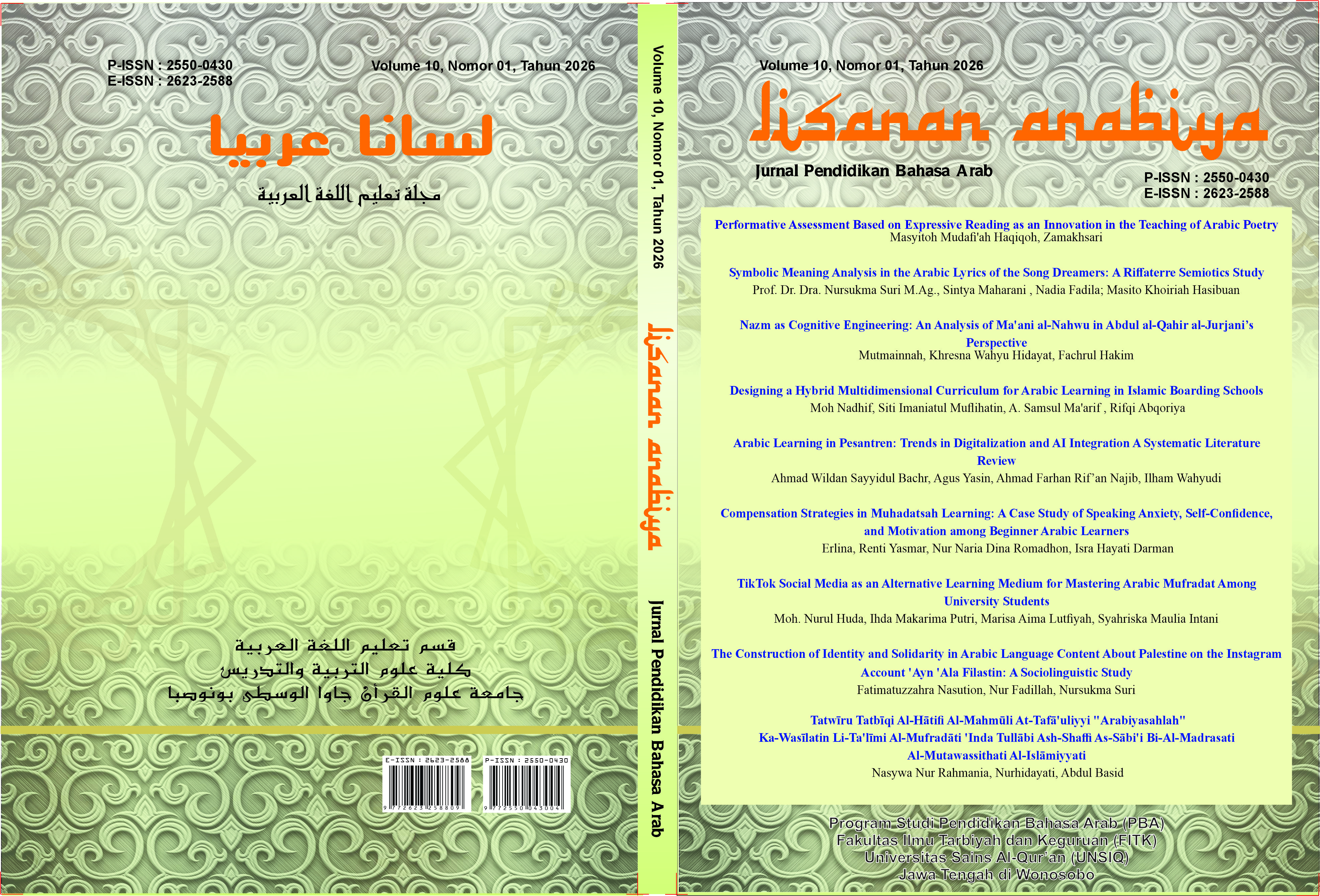
The Construction of Identity and Solidarity in Arabic Language Content About Palestine on the Instagram Account 'Ayn 'Ala Filastin: A Sociolinguistic Study
DOI:
https://doi.org/10.32699/htqsky54Kata Kunci:
Sociolinguistics, identity construction, solidarity, Arabic discourse, social mediaAbstrak
This study examines the construction of identity and solidarity in Arabic-language Instagram content related to Palestine from a sociolinguistic perspective. Social media has become a crucial space for expressing collective identity and mobilizing global solidarity. This research employs a qualitative approach using discourse analysis to investigate linguistic strategies in digital communication. The data consist of 15 selected Arabic captions from the Instagram account عين على فلسطين posted between January and March 2025. The analysis is based on the identity construction framework of Bucholtz and Hall (2005) and Critical Discourse Analysis by Fairclough (2015). The findings reveal that identity and solidarity are constructed through collective pronouns, emotional metaphors, and resistance-oriented expressions. These linguistic strategies not only reflect ideological positions but also strengthen emotional engagement and digital solidarity among audiences.
Referensi
Androutsopoulos, J. (2014). Mediatization and sociolinguistic change. Berlin: De Gruyter. ←Book
Barton, D., & Lee, C. (2013). Language online: Investigating digital texts and practices. London: Routledge. ←Book
Boudelaa, S., & Marslen-Wilson, W. D. (2010). Aralex: A lexical database for modern standard Arabic. Behavior Research Methods, 42(2), 481–487. ←Journal
Bucholtz, M., & Hall, K. (2005). Identity and interaction: A sociocultural linguistic approach. Discourse Studies, 7(4–5), 585–614. ←Journal
Chaer, Abdul. 2003. Linguistik Umum. Jakarta: Rineka Cipta. ←Book
Chyrvonyi, O. (2024). The evolution of social media language: A sociolinguistic analysis of recent neologisms. Transcarpathian Philological Studies, 35, 45–52. ←Journal
Creswell, J. W. (2014). Research design: Qualitative, quantitative, and mixed methods approaches (4th ed.). London: Sage Publications. ←Book
Crystal, D. (2011). Internet linguistics: A student guide. London: Routledge. ←Book
Di Marco, N., et al. (2024). Patterns of linguistic simplification on social media platforms over time. Proceedings of the National Academy of Sciences (PNAS), 121(50). ←Journal
Eye on Palestine (عين على فلسطين). (n.d.). Eye on Palestine [Instagram account]. Instagram. https://www.instagram.com/eye.on.palestine ←Website
Fairclough, N. (2015). Language and power (3rd ed.). London: Routledge. ←Book
Foyet, M., & Child, B. (2024). Social media and the rise of digital solidarity movements. Frontiers in Sociology, 9, 1–12. ←Journal
Gee, J. P. (2014). An introduction to discourse analysis: Theory and method (4th ed.). New York: Routledge. ←Book
Herring, S. C. (2013). Discourse in Web 2.0: Familiar, reconfigured, and emergent. In D. Tannen & A. M. Tester (Eds.), The handbook of discourse analysis (pp. 127–151). Oxford: Wiley-Blackwell. ←Book Chapter
Holmes, J. (2013). An introduction to sociolinguistics (4th ed.). London: Routledge. ←Book
Jaworski, A., & Coupland, N. (2014). The discourse reader (3rd ed.). London: Routledge. ←Book
Johnstone, B. (2018). Discourse analysis (3rd ed.). Oxford: Wiley Blackwell. ←Book
Pérez-Sabater, C. (2021). Moments of sharing: Language style and resources for solidarity on social media. Journal of Pragmatics, 180, 266–282. ←Journal
Subiakto, V. U., et al. (2025). Digital activism and collective identity: A systematic literature review of social media’s role in contemporary social movements. International Journal of Research and Innovation in Social Science (IJRISS). ←Journal
Tagg, C. (2015). Exploring digital communication: Language in action. London: Routledge. ←Book
Van Dijk, T. A. (2015). Critical discourse analysis. In D. Tannen, H. Hamilton, & D. Schiffrin (Eds.), The handbook of discourse analysis (2nd ed., pp. 466–485). Oxford: Wiley Blackwell. ←Book Chapter
Wardhaugh, R., & Fuller, J. M. (2015). An introduction to sociolinguistics (7th ed.). Oxford: Wiley Blackwell. ←Book
Zappavigna, M. (2018). Searchable talk: Hashtags and social media metadiscourse. London: Bloomsbury Academic. ←Book
Unduhan
Diterbitkan
Terbitan
Bagian
Lisensi
Hak Cipta (c) 2026 Fatimatuzzahra Nasution, Nur Fadillah, Nursukma Suri

Artikel ini berlisensiCreative Commons Attribution-ShareAlike 4.0 International License.
Authors who publish with this journal agree to the following terms:
a. Authors retain copyright and grant the journal right of first publication with the work simultaneously licensed under a Creative Commons Attribution-ShareAlike 4.0 International License. that allows others to share the work with an acknowledgement of the work's authorship and initial publication in this journal.
b. Authors are able to enter into separate, additional contractual arrangements for the non-exclusive distribution of the journal's published version of the work (e.g., post it to an institutional repository or publish it in a book), with an acknowledgement of its initial publication in this journal.
c. Authors are permitted and encouraged to post their work online (e.g., in institutional repositories or on their website) prior to and during the submission process, as it can lead to productive exchanges, as well as earlier and greater citation of published work (See The Effect of Open Access).

_(1).png)