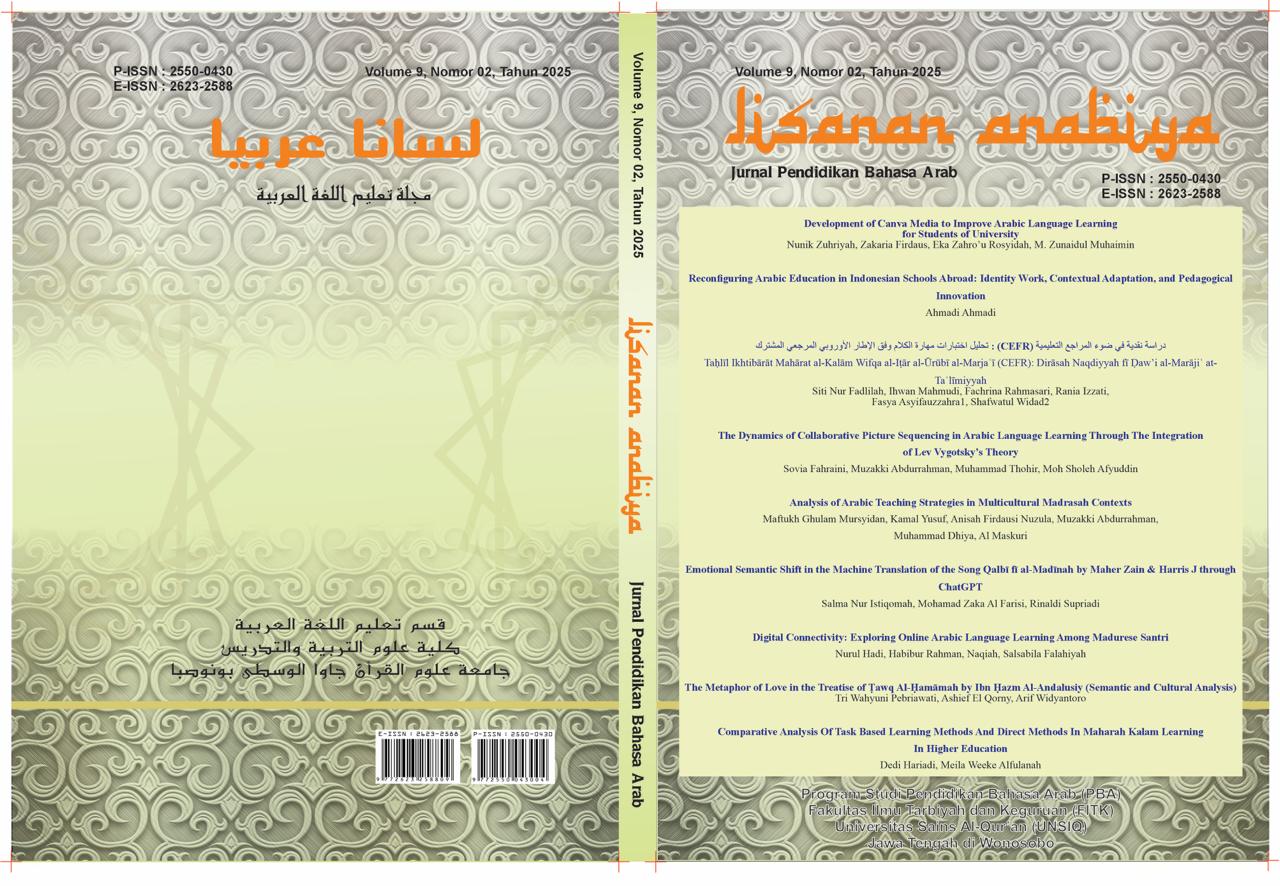
Comparative Analysis Of Task Based Learning Methods And Direct Methods In Maharah Kalam Learning In Higher Education
DOI:
https://doi.org/10.32699/1c0tnr87Keywords:
Task-Based Learning, Direct Method, Maharah KalamAbstract
Proficiency in maharah kalam is a core competency in Arabic language learning at the tertiary level. However, the main challenge lies in the weak integration between theory and language practice. This study aims to compare the effectiveness of Task-Based Learning (TBL) and Direct Method in developing maharah kalam. The research was conducted with a qualitative approach through a literature study, reviewing scientific articles, academic books, and relevant research results. The analysis was done descriptively-comparatively on the characteristics, application, advantages, and limitations of both methods. The results showed that TBL promotes contextual communication skills through authentic tasks, improving fluency and the ability to negotiate meaning. In contrast, the Direct Method is effective in practicing spontaneity of speech and pronunciation through structured repetition. Each method has advantages that suit the characteristics of learners in higher education. The integration of the two, tailored to situational needs and learning objectives, is recommended as a more adaptive and effective strategy for the development of maharah kalam. The findings provide a practical contribution to the development of Arabic language learning models that are relevant and responsive to global challenges.
References
Arifin, Z., Desrani, A., Wardana Ritonga, A., & Ibrahim, F. M. A. (2023). An Innovation in Planning Management for Learning Arabic at Islamic Boarding Schools. Nidhomul Haq : Jurnal Manajemen Pendidikan Islam, 8(1), 77–89. https://doi.org/10.31538/ndh.v8i1.3237
Astina, C., Rahman, R. A., Nurbayan, Y., & Burdah, I. (2025). Internalisasi Budaya Arab Melalui Pengenalan Ta’bir Arab Dalam Pembelajaran Maharah Al-Kalam. Lisanan Arabiya: Jurnal Pendidikan Bahasa Arab, 8(2), 188–203. https://doi.org/10.32699/liar.v8i2.8220
Asty, et al. (2025). Analisis Penerapan Metode Berbasis Tugas dalam Peningkatan Kompetensi Berbahasa Asing di Sekolah Menengah: Prespektif Linguistik Terapan. Pediaqu : Jurnal Pendidikan Sosial Dan Humaniora, 4(2), 195–222. https://doi.org/10.1201/9781032622408-13
Badriyyah, M. N. (2025). Fa ’aliyah Namudazi At Ta’lim At Taáwuni As Ilah Al Bithoqoh Fi Ta’liimi Mahaarah Al Kalam Ladai Tulab As Shofi Al Asyir Fil Madrasah Atsanawiyah Al Islamiyah Nahdhotil Ulama Mranggen Demak. Lisanan Arabiya: Jurnal Pendidikan Bahasa Arab, 09(01), 2–4.
Fazuhra, A., & Muhammad Samin, S. (2022). Hubungan Metode Pembelajaran Bahasa Arab Terhadap Minat Belajar Siswa SMPIT Insan Cendekia Kampar. Perspektif Pendidikan Dan Keguruan, 13(1), 47–54. https://doi.org/10.25299/perspektif.2022.vol13(1).9441
Haq, S. (2023). Pembelajaran Bahasa Arab di Era Digital: Problematika dan Solusi dalam Pengembangan Media. MUKADIMAH: Jurnal Pendidikan, Sejarah, Dan Ilmu-Ilmu Sosial, 7(1), 211–222. https://doi.org/10.30743/mkd.v7i1.6937
Manan, A., & Nasri, U. (2024). Tantangan dan Peluang Pendidikan Bahasa Arab: Perspektif Global. Jurnal Ilmiah Profesi Pendidikan, 9(1), 256–265. https://doi.org/10.29303/jipp.v9i1.2042
Mandalika, M. (2023). Analisis Strategi dan Metode Pembelajaran Bahasa Arab di Asrama Bahasa Arab Manhalun Nabighin. Jurnal Sathar, 1(1), 1–10. https://doi.org/10.59548/js.v1i1.38
Mubarok, M., Nizam, M., & Fitriani, F. (2022). Analisis Penerapan Metode Pembelajaran Bahasa Arab Kelas IV. Academicus: Journal of Teaching and Learning, 1(1), 1–10. https://doi.org/10.59373/academicus.v1i1.2
Mustafa, M. (2021). Dinamika Metode Pembelajaran Bahasa Arab. Loghat Arabi : Jurnal Bahasa Arab Dan Pendidikan Bahasa Arab, 1(2), 56. https://doi.org/10.36915/la.v1i2.17
Nugrahawan, A. R., Rafli, Z., & Setiadi, S. (2024). Model Kognitif Psikolinguistik Terkini dalam Menunjang Pembelajaran Struktur Bahasa Arab. Tarling: Journal of Language Education, 8(1), 147–166.
Pramesti, A., Dwi, A., Ritonga, J., Wildan, M., & Azkia, F. (2025). Mengungkap Faktor Penghambat dan Solusi Alternatif Pembelajaran Bahasa Arab di SMP IT Al-Hijrah Kelas IX. Al-Tarbiyah : Jurnal Ilmu Pendidikan Islam.
Rosfazila, Romadhon, N. N. D., Ramadhani, G. F., Langkau, M. H., Fikri, S., Rahman, H., Maisurah, F. L., Nunung Nur Mahmudah, Lindrianawati, D. M., Khasanah, N., Indah Fitriya, N., Rahmawati, N., Syamsul Arifin, A., Bahasa Asing, J., Bahasa dan Seni, F., Negeri Semarang, U., Harahap, S. M., Dwiani, A., Habibah, I. F., … Mukarromah, I. (2023). Tinjauan Sosiolinguistik terhadap Proses Pembelajaran Bahasa Arab Sosiolinguistic Review on Arabic Learning Proces. AKSARA: Jurnal Bahasa Dan Sastra, 2(1), 89–95. https://ojs.unida.ac.id/tatsqifiy/article/view/2569%0Ahttp://urj.uin-malang.ac.id/index.php/JPBA%0Ahttp://journal.unnes.ac.id/sju/index.php/laa
Sarif, S., Rahman, P. S., Mamonto, M. Z., Talibo, W., & Arab, P. B. (2025). Strategi Efektif Mengasah Maharah Al- Qiro ’ ah dalam Pembelajaran Bahasa Arab di Akademi Qur ’ an Al -Haramain , Malaysia. Khidmat Insani: Jurnal Pengabdian Masyarakat, 2, 11–20.
Saswati, R., & Arifin, S. (2024). Peningkatan Kemampuan Berbicara Siswa SMA Kelas X dengan Penerapan Pendekatan Task Based Language Teaching ( TBLT ). BERNAS: Jurnal Pengabdian Kepada Masyarakat, 5(4), 2743–2750.
Syahril, M., Nurshafnita, P., & Nasution, F. (2023). Metode Dalam Pembelajaran Bahasa Arab. EduInovasi: Journal of Basic Educational Studies, 3(1), 91–96. https://doi.org/10.47467/edui.v3i1.2869
Taufik et al. (2024). Menjadikan Pembelajaran Mufrodat Menyenangkan: Strategi Inovatif untuk Meningkatkan Motivasi Belajar Bahasa Arab di MI. Al-Madrasah: Jurnal Ilmiah Pendidikan Madrasah Ibtidaiyah, 8(4), 1842–1853. https://doi.org/10.35931/am.v8i4.4081
Downloads
Published
Issue
Section
License
Copyright (c) 2026 Dedi Hariadi, Meila Weeke Alfulanah

This work is licensed under a Creative Commons Attribution-ShareAlike 4.0 International License.
Authors who publish with this journal agree to the following terms:
a. Authors retain copyright and grant the journal right of first publication with the work simultaneously licensed under a Creative Commons Attribution-ShareAlike 4.0 International License. that allows others to share the work with an acknowledgement of the work's authorship and initial publication in this journal.
b. Authors are able to enter into separate, additional contractual arrangements for the non-exclusive distribution of the journal's published version of the work (e.g., post it to an institutional repository or publish it in a book), with an acknowledgement of its initial publication in this journal.
c. Authors are permitted and encouraged to post their work online (e.g., in institutional repositories or on their website) prior to and during the submission process, as it can lead to productive exchanges, as well as earlier and greater citation of published work (See The Effect of Open Access).


_(1).png)