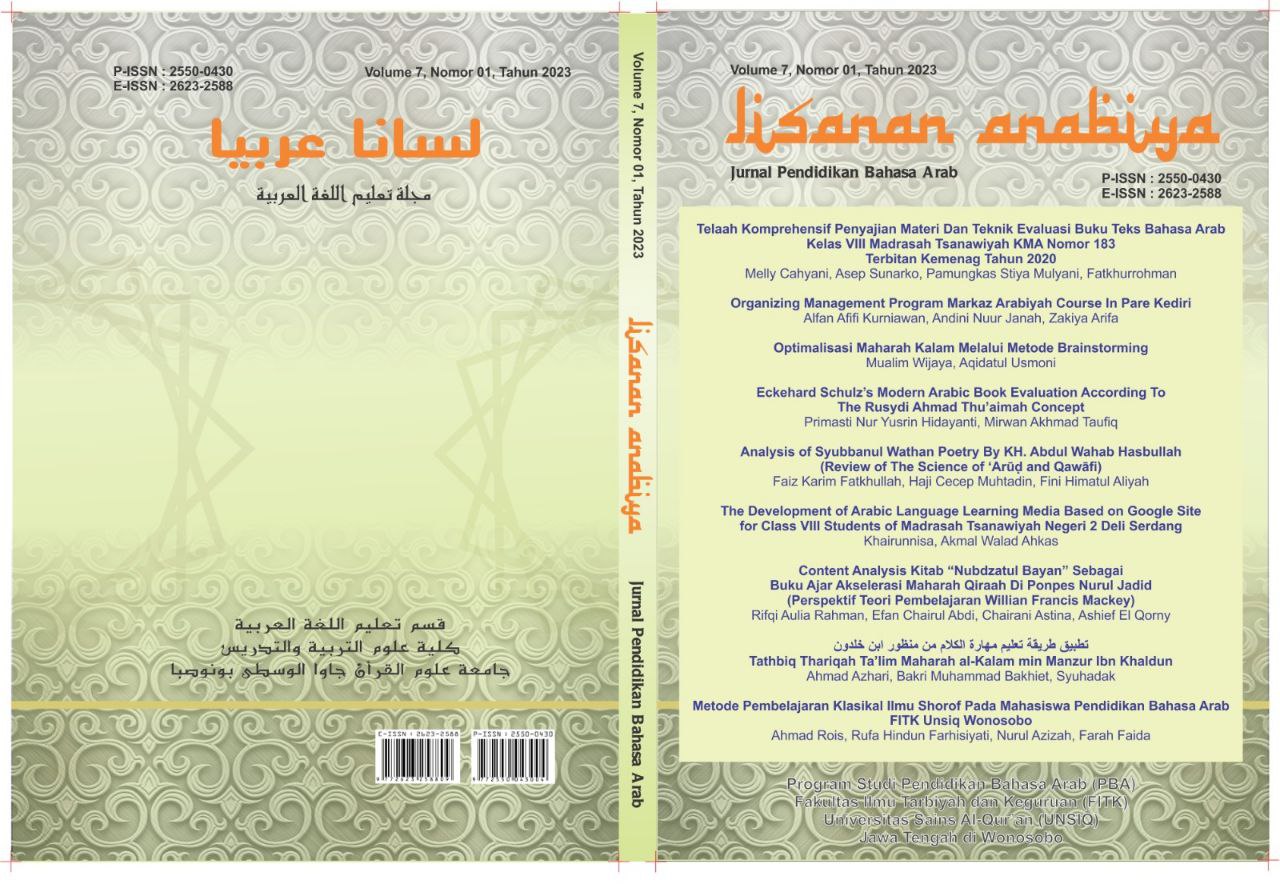
Analysis of Syubbanul Wathan Poetry By KH. Abdul Wahab Hasbullah
(Review of The Science of Arūḍ and Qawāfi)
DOI:
https://doi.org/10.32699/liar.v7i1.4429الكلمات المفتاحية:
Poetry, Syubbanul Wathan, Abdul Wahab Hasbullah. ‘Arūḍ, Qawāfi.الملخص
علم العروض و القوافي هما علم الشعر العربي العتيق الذي كان إهتمامه اليوم ناذرا بالتلاميذ. و لا تكنّ جاذر بالذكر في أن هذين العلمين لقد كانا لؤلؤة في التريخ الأدبي العربي. فيبحث هذا البحث في شعر كياهي الحاج عبد الوهاب حسب الله بموضوع "نظرا من حيث علم العروض و القوافي. تهدف هذا البحث إلى معرفة نوع البحر، و لتحديد الزحاف، العلة، و كذالك القوافي. فالطريقة المستخدمة في هذا البحث هي كيفي و صفي مع مراجعة الأدابيات، تستخدم الطريقة الوصفية بتوضيح التحصيل منها. البينات التي تم الحصول عليها في شكل الكلمة أو الجملة من شعر شبّان الوطن. فمن نتائج البحث يئشر إلى أنّ يستخدم هذا الشعر بحر الرجاز. كان زحاف داخلا ثلاثة و هي الخبن و الطي و الخبل. و كانت علة داخل إثنين هما القطع و التذييل. ثم بجانب ذالك، هناك ضروري من الشعر على شكل زيادة حرف الإشباع. الشكل من القاقية ثلاثة و هي بعض الكلمات, و كلمة, و كلمة مع بعضها. فحروف القافية ثلاثة و هي الويّ، والوصل، والردف. ثم حركات القافية ثلاثة هي الحذو، والتوجية، و المجرى. أسماء القافية ثلاثة و هي المتدارك، و المتواتر، و المترادف.
المراجع
Akbar, M. F. A. (2022). Analisis Kitab Alfiyah Ibn Malik Melalui Pendekatan Ilmu ‘Arudl wal Qawafi (Studi tentang bab muqaddimah dan bab fa’il kitab Alfiyah ibn malik). Universitas Islam Nusantara.
Amin, A. R. (2017). Menyatukan Perbedaan Syair Ya Ah (Lal) Wathan. In Harakatuna (p. 5). https://www.harakatuna.com/menyatukan-perbedaan-syair-ya-ah-lal-wathan.html
Damanhuri, M. (n.d.). Mukhtashar al-Syafi’ Ala Matan al-Kafi. Surabaya: Maktabah Imam.
Faizin, M. S., & Atisah, A. (2019). Syair “Ma Fi al-Maqami Lidzi ‘Aql Wa Dzi Adab” Karya Imam Syafi’i (Kajian Ilmu Arudh dan Qawafi). Lisanan Arabiya: Jurnal Pendidikan Bahasa Arab, 3(2), 201. https://doi.org/10.32699/liar.v3i2.1005
Faizin, M. S., & Atisah, A. (2020). Analisa Ilmu Arudh dan Qawafi dalam Syair al-I’tirof Karya Abu Nawas. Diwan : Jurnal Bahasa Dan Sastra Arab, 6(1), 48. https://doi.org/10.24252/diwan.v6i1.11190
Gunawan, M. A. (2018). Nilai-Nilai Islam Dalam Lagu Ya Lal Wathon dan Implementasinya Bagi Pengokohan Jiwa Nasionalisme Siswa MI Ma’arif Al-Hasani Gresik [Universitas Islam Negeri Maulana Malik Ibrahim]. http://etheses.uin-malang.ac.id/id/eprint/12502
Hamid, M. (1995). Ilmu Arudl dan Qawafi. Surabaya: Al-Ikhlas.
Haqqi, A. (1987). Al-Mufassal Fi Al-Arudh Wal Qawafi Wa Funun Al Syi’ri (1st ed.). Beirut: Dar Al-Rasid.
Jaddu, A., Kulla, Y., Syasi, A., & Arudh, S. (2022). Musical Rhythm in Poetry ‘Al Rhythm in Poetry ‘Al-Jaddu Yudni Kulla Amr Syasi’in’ by Imam Syafi’i (Critical Analysis of ‘Arudh and Qowafi)|Irama Musikalitas pada Puisi ‘Al Jaddu Yudni Kulla Amr Syasi’in’ Karya Imam Syafi’i (Analisis Kritik Sastra Arudh da. Mantiqu Tayr: Journal of Arabic Language, 2(2), 99. https://doi.org/10.25217/mantiqutayr.v2i2.2344
Kamil, S. (2019). Ensiklopedi Bahasa dan Sastra Arab. Depok: PT Raja Grafindo Persada.
Masykuri, M. S. (2017). Mudah Belajar ’Arudl (Ilmu Sya’ir Bahasa Arab). Kediri: Santri Salaf Press.
Moleong, L. J. (2013). Metode Penelitian Kualitatif, Edisi revisi. Bandung: PT Remaja Rosdakarya.
Umaya, N. M., & Harjito. (2017). Penelitian Pembelajaran Sastra. Semarang: Universitas PGRI Semarang Press.
Utsman, M. H. (1425). Al-Mursyidul Wafi fi Arudh wal Qawafi. Beirut: Dar Al-Kutub Al-Ilmiyah.
Zed, M. (2014). Metode Penelitian Kepustakaan (3rd ed.). Jakarta: Yayasan Pustaka Obor Indonesia.
التنزيلات
منشور
إصدار
القسم
الرخصة
Authors who publish with this journal agree to the following terms:
a. Authors retain copyright and grant the journal right of first publication with the work simultaneously licensed under a Creative Commons Attribution-ShareAlike 4.0 International License. that allows others to share the work with an acknowledgement of the work's authorship and initial publication in this journal.
b. Authors are able to enter into separate, additional contractual arrangements for the non-exclusive distribution of the journal's published version of the work (e.g., post it to an institutional repository or publish it in a book), with an acknowledgement of its initial publication in this journal.
c. Authors are permitted and encouraged to post their work online (e.g., in institutional repositories or on their website) prior to and during the submission process, as it can lead to productive exchanges, as well as earlier and greater citation of published work (See The Effect of Open Access).


_(1).png)