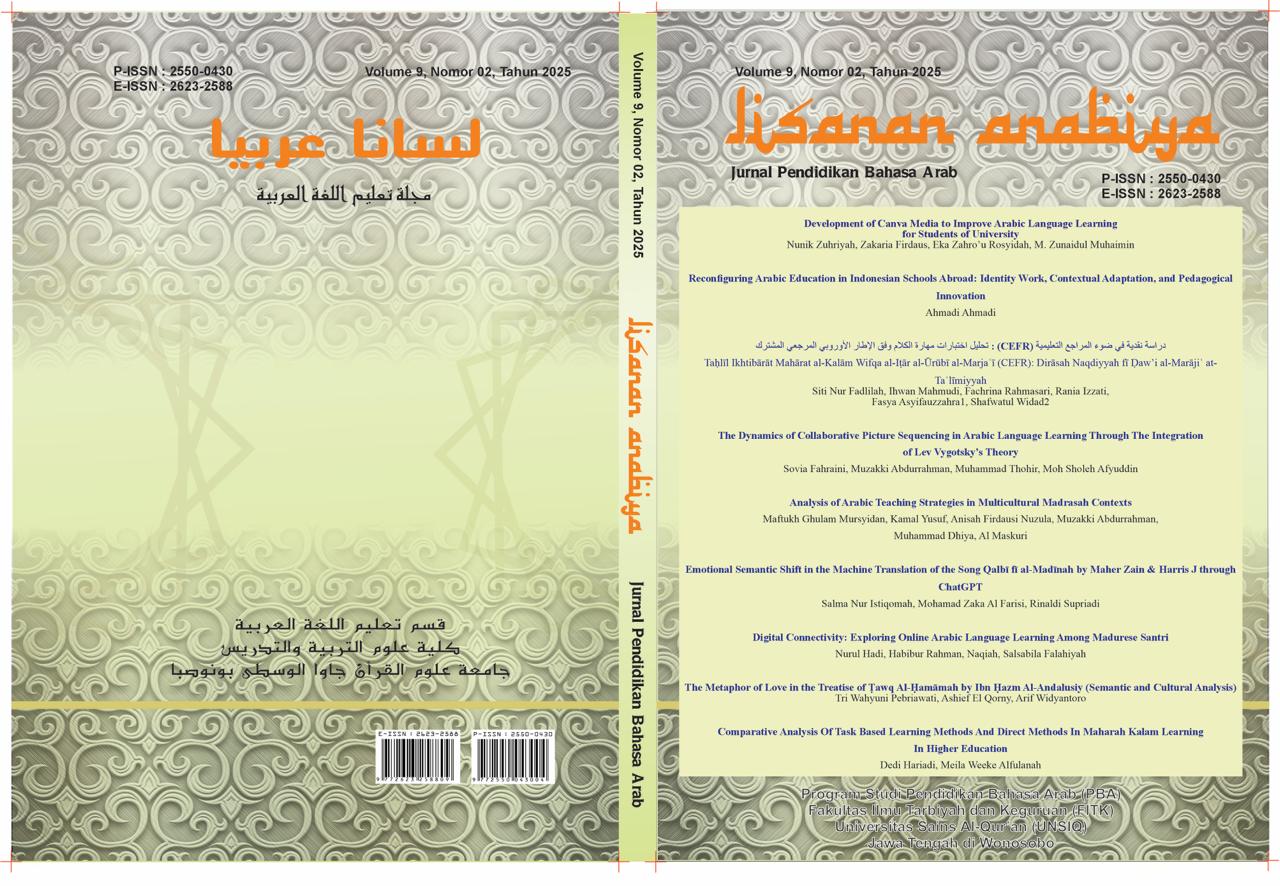
The Emotional Semantic Shift in the Machine Translation of the Song Qalbi Fil Madinah by Maher Zain & Harris J through ChatGPT
Emotional Semantic Shift in the Machine Translation of the Song Qalbi Fil Madinah by Maher Zain & Harris J through ChatGPT
DOI:
https://doi.org/10.32699/fx5bs604Keywords:
Arabic song translation, ChatGPT, Emotional meaning shift, Munday Theory, Semantic studyAbstract
This study departs from the assumption that emotional meanings such as affection, longing, and spirituality are highly sensitive to linguistic and cultural changes, and therefore often undergo attenuation or shift in the process of translation. The research examines the phenomenon of emotional meaning shifts in the machine translation of the Arabic religious song Qalbi Fil Madinah by Maher Zain and Harris J into Indonesian using ChatGPT. Employing a descriptive qualitative method grounded in Munday’s (2012) theory, this study analyzes how ChatGPT transfers affective and spiritual nuances from the source text to the target text. The data consist of Arabic song lyrics and their machine-generated translations, purposively selected based on their emotional and spiritual content. The analysis focuses on four types of emotional meaning shifts as outlined in Munday’s (2016) semantic theory: intensification, attenuation, polarity change, and neutralization. Based on the findings, ChatGPT demonstrates strong grammatical accuracy and structural cohesion but tends to neutralize emotional intensity and spiritual resonance particularly in metaphorical and culturally bound expressions. It is concluded that, despite the high linguistic flexibility of generative language models, their ability to preserve emotional equivalence across languages and cultures remains limited. This research highlights the urgency of evaluating machine translation performance in conveying the emotional and spiritual content of religious texts to maintain meaning equivalence. The findings also pave the way for the development of a new evaluation framework that assesses not only semantic adequacy but also cross-linguistic emotional fidelity, thereby contributing to the theoretical advancement of semantic–pragmatic studies through the application of Munday’s emotion-based meaning shift model in the context of AI-driven translation.
Keywords: Arabic song translation, ChatGPT , Emotional meaning shift, Munday Theory, Semantic study
References
Bąk, H. (2023). Issues in the translation equivalence of basic emotion terms. Ampersand, 11(June). https://doi.org/10.1016/j.amper.2023.100128
Beata, K. (2007). Cognitive Linguistics By W . Croft And D . A . Cruse . Cambridge University Press , 2004 . PP . 356 . Studia Anglica Resoviensia 4 Beata, 250–254.
Budimir, B. (2025). The Challenge of Translating Culture-Specific Items: Evaluating MT and LLMs Compared to Human Translators. Proceedings of Machine Translation Summit XX, 1, 455–467. https://aclanthology.org/2025.mtsummit-1.36/
Celen, E., van Rijn, P., Lee, H., & Jacoby, N. (2025). Are Expressions for Music Emotions the Same Across Cultures? Arxiv. http://arxiv.org/abs/2502.08744
Chen, R. (2013). Cognitive Linguistics Research. In English Inversion. https://doi.org/10.1515/9783110895100.335
Dawood, O. (2025). Translating Arabic Love Paronomasial Terms into English: A Pragmatic Analysis. Al-Noor Journal for Humanities, 3(1), 125–155. https://doi.org/10.69513/jnfh.v3.i1.en5
Gaanoun, K., & Alsuhaibani, M. (2025). Sentiment preservation in Quran translation with artificial intelligence approach: study in reputable English translation of the Quran. Humanities and Social Sciences Communications, 12(1), 1–15. https://doi.org/10.1057/s41599-024-04181-0
Gritsenko, E., & Aleshinskaya, E. (2016). Translation of Song Lyrics as Structure-related Expressive Device. Procedia - Social and Behavioral Sciences, 231(May), 165–172. https://doi.org/10.1016/j.sbspro.2016.09.087
Horn, L. R. (2008). Explorations in Pragmatics. In Deutsche Nationalbibliothek. https://doi.org/10.1515/9783110198843.1.39
Izu, O. B. (2022). Song Texts as a Means of Conveying Cultural Meanings. ADRRI Journal of Arts and Social Sciences, 19(1), 2343–6891.
Jiao, W., Wang, W., Huang, J., Wang, X., Shi, S., & Tu, Z. (2023). Is ChatGPT A Good Translator? Yes With GPT-4 As The Engine. Arxiv. http://arxiv.org/abs/2301.08745
Lumbard, J. E. B. (2007). From Hubb to lhringIshq: The Development of Love in Early Sufism. Journal of Islamic Studies, 18(3), 345–385. https://doi.org/10.1093/jis/etm030
Metwally, A. A., & Bin-Hady, W. R. A. (2025). Exploring human vs. AI-powered translation to metonymic expressions: A case study of the Holy Quran. Social Sciences and Humanities Open, 12(August), 101615. https://doi.org/10.1016/j.ssaho.2025.101615
Miraxatova, D. (2025). Lexical and Grammatical Means of Expressing the Modal Meanings of Possibility and Impossibility in Modern Standard Arabic. Sarcouncil Journal of Arts and Literature, 04(04), 40–45.
Munday, J. (2016). Introducing Translation Studies: Theories and Applications. In Introducing Translation Studies: Theories and Applications. Routledge Taylor & Francis Group. https://doi.org/10.4324/9781315691862
Novianingsih, D. U., Amelia, F., & Novitasari, N. F. (2022). The Beauty of Words in Maher Zain’s Selected Song Lyrics: A Study of Connotative Meaning. ELLITE: Journal of English Language, Literature, and Teaching, 7(1), 60–72. https://doi.org/10.32528/ellite.v7i1.7820
Omar, N., & Kadhim, K. A. (2025). The Effects of Using AI on the Quality of Translational Product: A Reference to Religious Translation. In Al-Noor Journal for Humanities (Vol. 3, Issue 1). https://doi.org/10.69513/jnfh.v3.i1.en1
Steuernagel, M. S. (2021). Transnational and Translational Aspects of Global Christian Congregational Musicking. Religions, 12(9), 1–18. https://doi.org/10.3390/rel12090732
Suharto, S., & Subroto, E. (2014). The Equivalence of Translated Songs Lyrics and their Effects - The Case of Translated Ecclesial Songs. Harmonia: Journal of Arts Research and Education, 14(2), 131. https://doi.org/10.15294/harmonia.v14i2.3294
Troiano, E., Klinger, R., & Padó, S. (2020). Lost in Back-Translation: Emotion Preservation in Neural Machine Translation. COLING 2020 - 28th International Conference on Computational Linguistics, Proceedings of the Conference, 4340–4354. https://doi.org/10.18653/v1/2020.coling-main.384
Downloads
Published
Issue
Section
License
Copyright (c) 2025 Salma Nur Istiqomah, Mohamad Zaka Al Farisi, Rinaldi Supriadi

This work is licensed under a Creative Commons Attribution-ShareAlike 4.0 International License.
Authors who publish with this journal agree to the following terms:
a. Authors retain copyright and grant the journal right of first publication with the work simultaneously licensed under a Creative Commons Attribution-ShareAlike 4.0 International License. that allows others to share the work with an acknowledgement of the work's authorship and initial publication in this journal.
b. Authors are able to enter into separate, additional contractual arrangements for the non-exclusive distribution of the journal's published version of the work (e.g., post it to an institutional repository or publish it in a book), with an acknowledgement of its initial publication in this journal.
c. Authors are permitted and encouraged to post their work online (e.g., in institutional repositories or on their website) prior to and during the submission process, as it can lead to productive exchanges, as well as earlier and greater citation of published work (See The Effect of Open Access).


_(1).png)