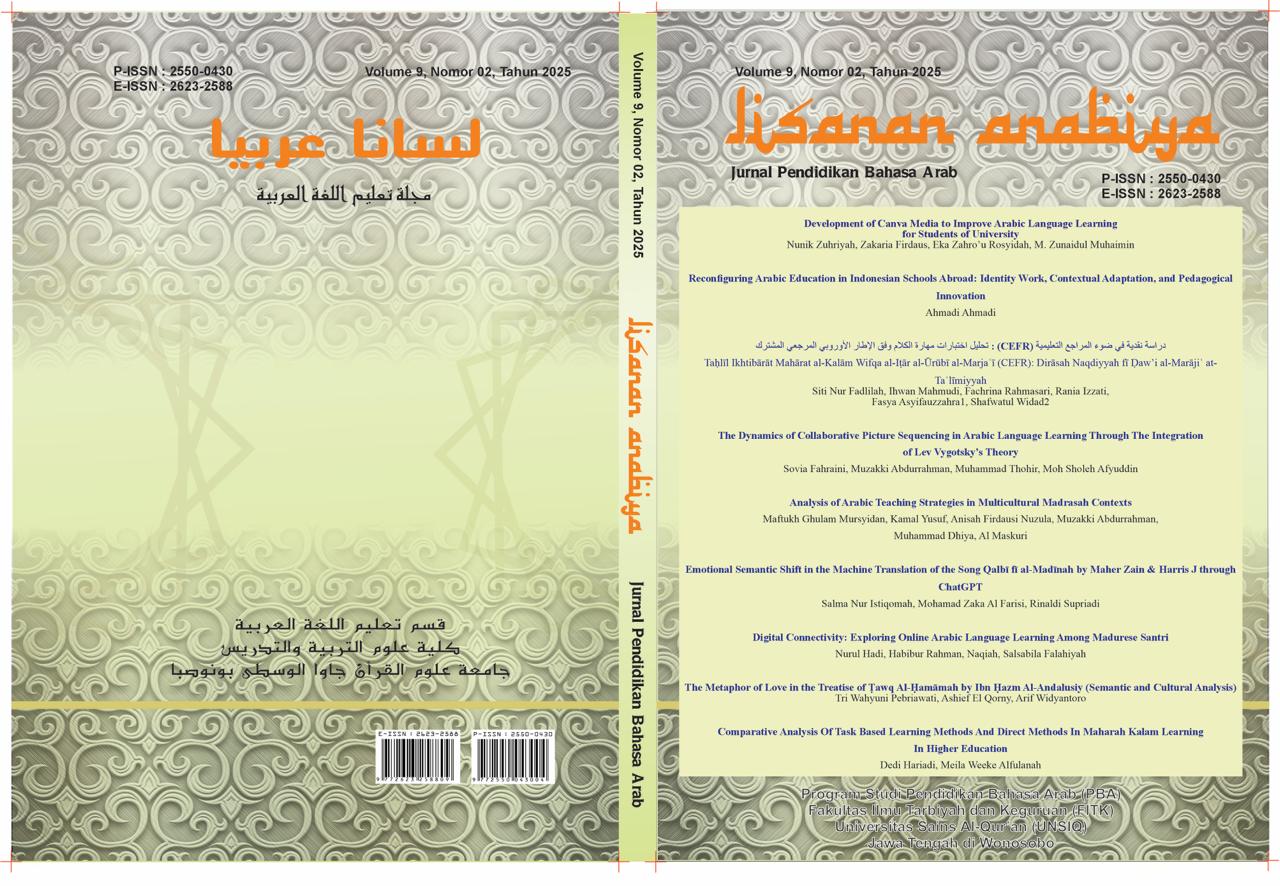
Arabic Language Teaching Strategies in a Multicultural Environment: An Analysis of Practices in Madrasah
DOI:
https://doi.org/10.32699/5kqh8r53Keywords:
Arabic language teaching; multicultural education; adaptive strategiesAbstract
This study explores effective strategies for teaching Arabic in multicultural madrasah environments. It aims to analyze how teachers plan and implement Arabic instruction that reflects students’ linguistic diversity, cultural backgrounds, and learning needs. The research applies a qualitative case study design across several madrasahs with data collected through classroom observations, teacher interviews, and analysis of instructional documents. The findings show that adaptive and inclusive strategies such as communicative methods based on cultural context, differentiated instruction, collaborative learning, and the use of digital media increase students’ engagement, motivation, and communicative competence. The study also highlights the importance of teachers’ creativity, intercultural awareness, and technological skills in managing diverse classrooms. The results contribute to the development of innovative Arabic language teaching models that are relevant to multicultural education and provide practical insights for teachers and policymakers to improve Arabic education quality.
References
Aziz, M. T., Hasan, L. M. U., & Adhimah, S. (2024). Jembatan Kurikulum: Inklusi dan Pembelajaran Bahasa Arab dalam Konteks Multikultural. Journal of Practice Learning and Educational Development, 4(3), 158–166. https://doi.org/10.58737/jpled.v4i3.292
Bakti, I. K., Kurniawan, R., Mukhlishah, Mudlofir, A., Kusaeri, & Bahri, R. (2025). Integrating Islamic values in inclusive madrasa education: a unique approach for special needs students. International Journal of Inclusive Education. https://doi.org/10.1080/13603116.2025.2555397
Dirjen Dikti Kemendikbud. (2020). Buku Panduan Pelayanan Merdeka Belajar dan Kampus Merdeka. In Merdeka Belajar-Kampus Merdeka.
Issn, A., Scientific, I., Chief, C., Assessment, H., & Review, D. B. (2024). CONSTRUCTION OF PERSONAL IDENTITY THROUGH LINGUISTIC DEVICE : AN ANTHROPOLOGIAL LINGUISTICS ANALYSIS 1 INTRODUCTION The relationship between language and identity has been widely explored in sociolinguistics and linguistic anthropology . Previous research. RGSA – Revista de Gestão Social e Ambiental, 1–21.
Johnson, J. L., Adkins, D., & Chauvin, S. (2020). A review of the quality indicators of rigor in qualitative research. American Journal of Pharmaceutical Education, 84(1), 138–146. https://doi.org/10.5688/ajpe7120
Latif, M., & Hafid, E. (2021). multicultural attitudes in an Islamic boarding school of South Sulawesi–Indonesia. Cogent Education, 8(1). https://doi.org/10.1080/2331186X.2021.1968736
Latifah, A. A. (2025). Transformasi Kurikulum Bahasa Arab Di Indonesia: Telaah Historis, Filosofis, Dan Inovasi Terkini. LEARNING : Jurnal Inovasi Penelitian Pendidikan Dan Pembelajaran Vol. 5 No. 3 Agustus 2025 E-ISSN :, 5(3), 167–186.
Lestari, W. Y., Surtikanti, H. K., Rahman, T., & Riandi, R. (2025). Integrating local potential in science learning: A contextual approach to the independent curriculum in Ciamis, West Java. Multidisciplinary Science Journal, 8(3), 1–11. https://doi.org/10.31893/multiscience.2026169
Masturoh, F., & Mahmudi, I. (2023). Implementasi Kurikulum Merdeka Belajar dalam Pembelajaran Bahasa Arab. Kalamuna: Jurnal Pendidikan Bahasa Arab Dan Kebahasaaraban, 4(2), 207–232. https://doi.org/10.52593/klm.04.2.07
Montes, V. M. (2025). Educational Trends in 21st Century Education. 2025 Institute for the Future of Education Conference, IFE 2025. https://doi.org/10.1109/IFE63672.2025.11024991
Muh. Asriadi, A. M., Hadi, S., & Istiyono, E. (2023). Trend research mapping of differentiated instruction: A bibliometric analysis. Journal of Pedagogical Research, 7(3), 194–210. https://doi.org/10.33902/JPR.202320544
Munip, A. (2020). Tantangan dan Prospek Studi Bahasa Arab di Indonesia. Al Mahāra: Jurnal Pendidikan Bahasa Arab, 5(2), 303–318. https://doi.org/10.14421/almahara.2019.052.08
Muslih, M., Bakar, Y. A., Negeri, U. I., & Ampel, S. (2025). INOVASI PENILAIAN PENGAJARAN BAHASA ARAB UNTUK SISWA DENGAN MODEL PENDEKATAN DIFERENSIASI. 6(2), 171–188.
Nurbayan, Y., & Sanusi, A. (2025). Integrating Character Values and EdTech Media: A Study of Arabic Teachers’ Pedagogical Competence in Bandung Raya. International Journal of Learning, Teaching and Educational Research, 24(8), 248–271. https://doi.org/10.26803/ijlter.24.8.11
Singer, N. (2025). Bridging Cultural Gaps through Mass Communication: The Role of Digital Media in Transforming English Language Teaching and Cognitive Development. Arab World English Journal, 16(1), 27–42. https://doi.org/10.24093/awej/vol16no1.2
Sopian, A., Abdurahman, M., ‘ali, M., Tantowi, Y. A., Aeni, A. N., & Maulani, H. (2025). Arabic Language Learning in a Multicultural Context At Pesantren. Jurnal Pendidikan Islam, 11(1), 77–89. https://doi.org/10.15575/jpi.v11i1.44104
Szabó, F., & Csépes, I. (2022). Constructivism in language pedagogy. Hungarian Educational Research Journal, 13(3), 405–417. https://doi.org/10.1556/063.2022.00136
Weeke Alfulana, M., Hanifah, U., & Aziz bin Sulaiman, A. (2025). The Rugency of Digital Technology Transformation in the Arabic Language Education: Media and Learning Strategies The Urgency of Digital Technology Transformation in the Arabic Language Education: Media and Learning Strategies Pentingnya Transformasi Tekno. Mahara, 11(1), 69–82. https://doi.org/10.14421/almahara.2025.
Zulkarnain, Y., & Abdullah Khoir, M. (2023). Penerapan pembelajaran berdiferensiasi dalam meningkatkan kemampuan bahasa Arab pada siswa madrasah aliyah negeri 2 Sragen. At Turots: Jurnal Pendidikan Islam, 5(2), 1160–1172. https://doi.org/10.51468/jpi.v5i2.322
Downloads
Published
Issue
Section
License
Copyright (c) 2025 Maftukh Ghulam; Anisah Firdausi Nuzula, Muzakki Abdurrahman, Kamal Yusuf

This work is licensed under a Creative Commons Attribution-ShareAlike 4.0 International License.
Authors who publish with this journal agree to the following terms:
a. Authors retain copyright and grant the journal right of first publication with the work simultaneously licensed under a Creative Commons Attribution-ShareAlike 4.0 International License. that allows others to share the work with an acknowledgement of the work's authorship and initial publication in this journal.
b. Authors are able to enter into separate, additional contractual arrangements for the non-exclusive distribution of the journal's published version of the work (e.g., post it to an institutional repository or publish it in a book), with an acknowledgement of its initial publication in this journal.
c. Authors are permitted and encouraged to post their work online (e.g., in institutional repositories or on their website) prior to and during the submission process, as it can lead to productive exchanges, as well as earlier and greater citation of published work (See The Effect of Open Access).


_(1).png)