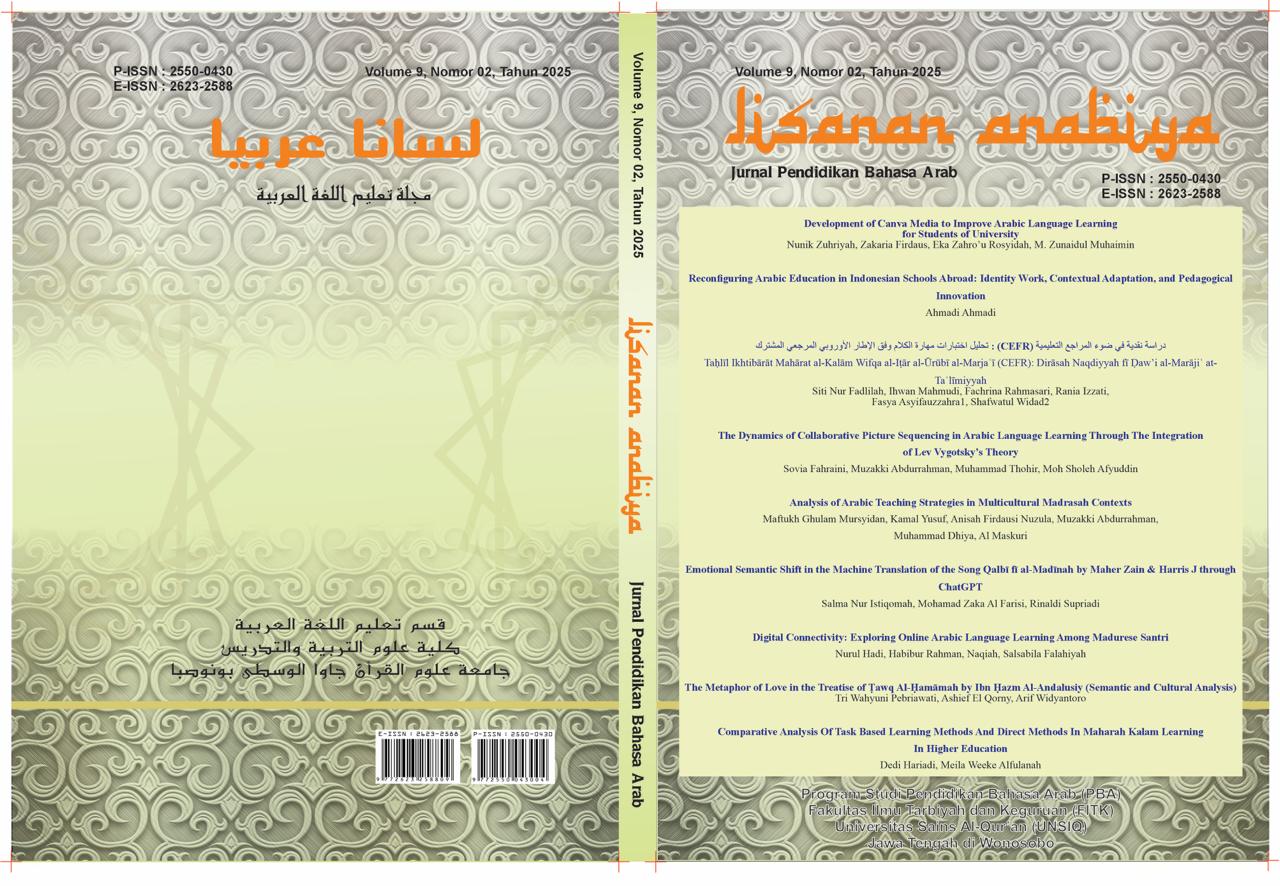
The Metaphor of Love in the Treatise of Ṭawq Al-Ḥamāmah by Ibn Ḥazm Al-Andalusiy (Semantic and Cultural Analysis)
DOI:
https://doi.org/10.32699/9jphay25Keywords:
Love of Metaphor, semantics, Ibn Ḥazm, Ṭawq al-ḤamāmahAbstract
This study examines the metaphor of love in the treatise Ṭawq al-Ḥamāmah by Ibn Ḥazm al-Andalusiy using semantic and cultural approaches. The goal is to identify the types of semantic fields of love metaphors based on Michael C. Haley's theory, explain the relationship of metaphors with Arab-Andalusian culture, and interpret Ibn Ḥazm's concept of love as depicted in his metaphorical expressions. This research is qualitative with descriptive-analytical methods and library research types. The primary data is in the text of Ṭawq al-Ḥamāmah, while the secondary data includes linguistic literature, metaphors, and classical Arabic culture. The analysis is carried out through documentation techniques, symbolic and semantic readings, and metaphor classification based on semantic field theory and cultural metaphors. The study results show eight categories of semantic fields, with the dominance of being, object, and human, and the strong influence of Andalusian culture on the construction of metaphorical meaning. According to Ibn Ḥazm, love is understood paradoxically, spiritually, abstractly, transcendently, and procedurally.
References
Abd Alghani, J. (2016). “On the way of truth”: IBN Hazm’s Tawq Al-Hama¯mah and the epistemology of love. Acta Orientalia, 69(1), 37–62. https://doi.org/10.1556/062.2016.69.1.3
Alonso, U. (1984). Cultural origins of the experience and manifestation of the religious in Andalusia, and its therapeutic function (Part I) Urbano Alonso del Campo. 2, 1–11.
Aminov, T. M., & Yakupov, M. T. (2022). Art of Love in Work of Ibn Hazm “Ring of Dove.” Nauchnyi Dialog, 11(7), 252–265. https://doi.org/10.24224/2227-1295-2022-11-7-252-265
Arianto, A. K. (2018). MEDAN MAKNA PEMBENTUK METAFORA DALAM SYAIR ARAB. Widyaparwa: Jurnal Ilmiah Kebahasaan Dan Kesastraan, 46(2), 112–125. http://www.biblioteca.pucminas.br/teses/Educacao_PereiraAS_1.pdf%0Ahttp://www.anpocs.org.br/portal/publicacoes/rbcs_00_11/rbcs11_01.htm%0Ahttp://repositorio.ipea.gov.br/bitstream/11058/7845/1/td_2306.pdf%0Ahttps://direitoufma2010.files.wordpress.com/2010/03/emi
ÇELİK, N. (2022). DîvânuLugâti̇’T-Türk‘Te Aşk VSevgi̇li̇yeDai̇r Kavramlarda KullanilanMetafori̇k Unsurlar. Selçuk Üniversitesi Türkiyat Araştırmaları Dergisi, 54, 287–300. https://doi.org/10.21563/sutad.1130523
de la Paz Estevez, M. (2009). ANALES DE HISTORIA ANTIGUA, MEDIEVAL Y MODERNA Volumen 41 – 2009. 1555, 1–10.
Demjén, Z., & Semino, E. (2017). Introduction: Metaphor and language (pp. 1–10). Routledge. https://doi.org/10.4324/9781315672953-9
Dhar Dwivedi, L. (2016). Metaphor: A Key Ingredient in Common and Literary Discourse. An International Peer-Reviewed Journal, 18, 50–52. www.iiste.org
Ding, E. (2009). Metaphor and Culture. Asian Social Science, 5(1), 197–220. https://doi.org/10.5539/ass.v5n1p47
Gibbs Jr, R. W., & Wilson, N. L. (2002). Bodily action and metaphorical meaning. Style, 36(3), 524–540.
Górska, E. (2009). On the diversity of linguistic evidence for conceptual metaphor. Studia Anglica Posnaniensia, 45(2), 81–106. https://doi.org/10.2478/v10121-009-0017-2
He, K. (2016). Influences of Cultural Elements on Metaphor. English Language and Literature Studies, 6(2), 126. https://doi.org/10.5539/ells.v6n2p126
Knowles, M., & Moon, R. (2004). Introducing metaphor. Routledge.
Kompa, N. (2017). The myth of embodied metaphor. Croatian Journal of Philosophy, 17(50), 195–210.
Kövecses, Z. (2005). Metaphor in culture: Universality and variation. Cambridge university press.
Kramsch, C. (2001). Language and Culture. Sociology, 2(2), 254–255. https://doi.org/10.1177/003803856800200229
Li, D., & Chi, D. (2020). A Sweet and Painful Emotional Experience: Love Metaphors from a Cross-Cultural Perspective. International Journal of English Linguistics, 10(6), 137. https://doi.org/10.5539/ijel.v10n6p137
Lumbezzi, L. (2020). IBN ḤAZM EN CÓRDOBA Y LOS RASGOS TÍPICOS DEL TOPOS DEL AMOR. 2, 306–312.
Mahmud, S. A., & Mustafa, I. I. (2023). Incorporation and Marginalization at the Level of Characters in a Book Dove Collar. Govarî Kurdistanî Bo Lêkołînewey Stratîcî, 1. https://doi.org/10.54809/jkss.vi1.211
Martínez Medina, F. J. (2015). Cristianos y musulmanes en la Andalucía moderna. La Granada del siglo XVI, una ciudad intercultural: Invenciones de reliquias y libros plúmbeos. http://hdl.handle.net/10481/41358
Mukhlisa, D. (2014). Metafora Cinta Dalam Karya–Karya Shakespeare. Universitas Gadjah Mada.
Nurkholis, Purnomo, D., & Irham, M. (2023). Qira’ah al-Tasybih al-Damny Fi Diwan al-Imam al-Syafi’i (Dirasah Balagiyyah). An Naba: Jurnal Pemikiran Dan Penelitian Pendidikan Islam, 6(1), 54–65. https://ejurnal.darulfattah.ac.id/index.php/Annaba
Pamies, A., Chunyi, L., & Craig, M. (2015). “Fruits are Results”: On the Interaction between Universal Archi-Metaphors, Ethno-Specific Culturemes and Phraseology. Journal of Social Sciences, 11(3), 227–247. https://doi.org/10.3844/jssp.2015.227.247
Ridwan, D. (2020). Gagasan Islam Cinta: Sebuah Telaah Filosofis. Ushuluna: Jurnal Ilmu Ushuluddin, 6(1), 107–130. https://doi.org/10.15408/ushuluna.v6i2.15816
Scattolin, G., & Anwar, A. H. (2020). Love in the History of Sufism Experience and Language. مجلة کلیة الآداب .جامعة بورسعید, 16(16), 23–59. https://doi.org/10.21608/jfpsu.2020.44050.1017
Shin-qing, Z. (2011). An Investigation Into Cognitive Motivations and Philosophical Cultural Origins of Similarities and Discrepancies in Cross-language Love Metaphors. Journal of Northwest A&F University.
Taira, T., & Kusumi, T. (2011). A review of metaphor research. Japanese Journal of Psychology, 82(3), 283–299. https://doi.org/10.4992/jjpsy.82.283
Tissari, H. (2001). Metaphors We Love By: On the Cognitive Metaphors of Love from the 15th Century to the Present.
Vereza, R. R. (2011). Assimilação do grupo moçárabe após a conquista de Toledo no século XI: questões a discutir (Mozarabic Group assimilation after the conquest of Toledo in the eleventh century: issues to be discussed) - DOI: 10.5752/P.2237-8871.2010v14n11p29. Cadernos de História, 11(14), 29–46. https://doi.org/10.5752/p.2237-8871.2010v11n14p29
Zhaparova, A. Z., Kenzhekanova, K. K., Azimbayeva, I. K., Fauconier, G., Reddy, M. J., & Pantner, D. (2022). THE PROBLEM OF METAPHOR It is well-known that Linguistics and Literary ences . In the field of Linguistics and Literary Stud - 1965 : 158 ). A distinguished professor in the field of Psycholinguistics and Cognitive Science from the University of Californi. 3(187), 25–31.
Downloads
Published
Issue
Section
License
Copyright (c) 2026 Tri Wahyuni Pebriawati; Ashief El Qorny

This work is licensed under a Creative Commons Attribution-ShareAlike 4.0 International License.
Authors who publish with this journal agree to the following terms:
a. Authors retain copyright and grant the journal right of first publication with the work simultaneously licensed under a Creative Commons Attribution-ShareAlike 4.0 International License. that allows others to share the work with an acknowledgement of the work's authorship and initial publication in this journal.
b. Authors are able to enter into separate, additional contractual arrangements for the non-exclusive distribution of the journal's published version of the work (e.g., post it to an institutional repository or publish it in a book), with an acknowledgement of its initial publication in this journal.
c. Authors are permitted and encouraged to post their work online (e.g., in institutional repositories or on their website) prior to and during the submission process, as it can lead to productive exchanges, as well as earlier and greater citation of published work (See The Effect of Open Access).


_(1).png)